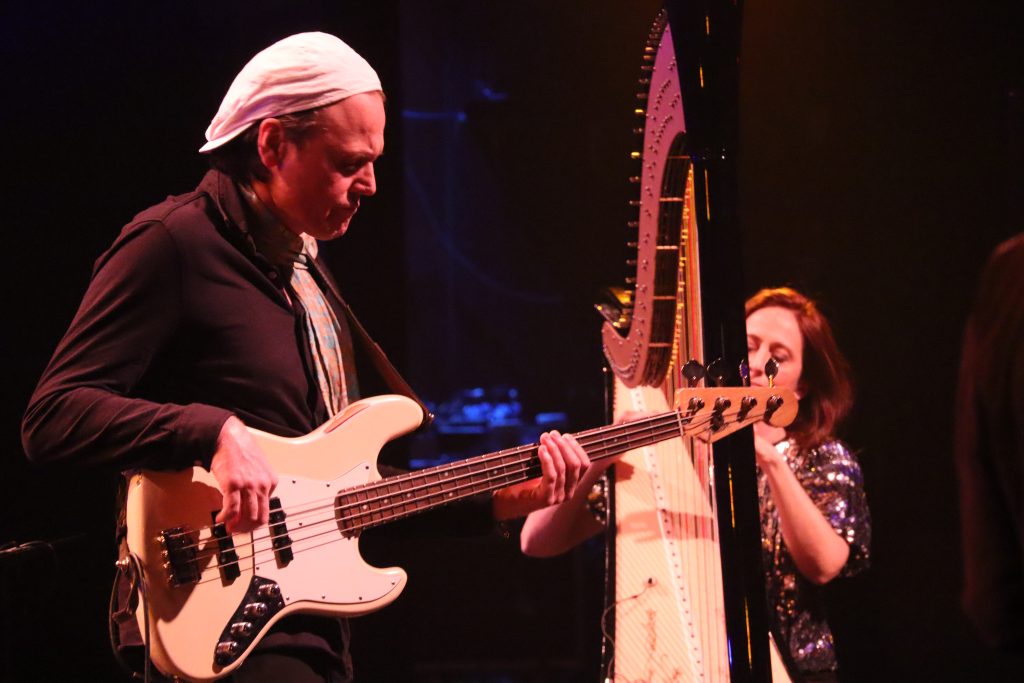
Last year, Camac's MIDI harp won the Max Matthews Prize for technological innovation at the seventh Qwartz Awards in Paris. Now Elisabeth Valletti, who performed on the MIDI harp at the prizegiving ceremony, is in the running for the eighth Awards (musical experimentation category)! She has been nominated for her eighteen "Exercices pour la Harpe MIDI", which include the Harp Haikus she performed when the MIDI harp won its prize.
VERY IMPORTANT: this prize has a public vote, which you can cast here. The closing date for voting is February 15th.
Speaking of avant-garde harp music: I've just added some concert dates with Hélène Breschand to the Harpblog calendar. If you haven't heard of Hélène's work, you can read an article about her in the Autumn 2008 edition of Harpseasons. You can also browse her website, and that of her ensemble Laborinthus.
Rhodri Davies is performing the distinguished avant-garde composer Elaine Radigue's Occam I for solo harp on February 23rd at Beursschouwburg in Brussels (8:30 PM). Saxophonist John Butcher will then perform his own solo work, The Geometry of Sentiment, before he and Rhodri conclude the evening with a duo improvisation. For more details, click here.
Rhodri gave the world premiere of Radigue's composition in the summer of last year, at the Spitalfields Festival in London. One reviewer writes: "His journey up the harp, sounding out octaves, fifths and minor seconds with his two bows, unchained the hidden harmonics of these notes, the upper partials, and allowed them to engage in a most mesmerising celestial dance above our heads, a sort of musical aurora borealis..." .
Just Not Cricket! has been initiated by Antoine Prum, the director of "Sunny's Time Now" about the drummer and free jazz key figure Sunny Murray. The idea of the festival is to give a sense of the British avant-garde / impro scene, and Prum will also film a documentary during the festival. Incidentally, the festival is also being sponsored by the new music magazine The Wire, who are collaborating on an extensive programme book.
Rhodri is performing various sets in various ensembles, together with Lol Coxhill, Alex Ward, Steve Beresford, John Edwards, Phil Minton, Dominic Lash, Orphy Robinson, Trevor Watts, Gail Brand, Mark Sanders, Tony Bevan, Matthew Bourne and Eddie Prévost. More information is available from the festival website.
"Young Scottish maestro Ailie Robertson has fine taste - in 11 tracks with titles like Boiling Point, The Cooperage, The Angel's Share and Amber Gold, she devotes her latest album to whisky.
Cast around the old Gaelic air Ho Ro Mo Bhobag an Dram (The Favourite Dram), she has composed and arranged everything else in the suite for her harp, plus classy fiddles, guitar, sax, whistles and piano, bass and percussion, all performed with modern, imaginative and fluidly adventurous creativity."
If you're in Scotland on Saturday June 4th, there is also another chance to hear the Traditional Spirits programme performed, at the Glenkinchie Distillery in East Lothian. The evening will begin with a tour of the distillery, followed by whisky tasting, and then the concert. All proceeds from the event will go towards supporting 'Love Oliver', a charity that helps fund research into childhood cancers. It also aims to provide practical help to families on Ward 2 at Edinburgh's Royal Hospital for Sick Children.
Secondly, Eleanor Turner has uploaded two of her compositions to YouTube, including a work I've always loved and whenever I've had the chance, I've gone on to anyone who'll listen about how more people should play it. I REALLY LOVE THIS PIECE...MORE PEOPLE SHOULD PLAY IT...etc.
You can also buy a CD of Eleanor's own excellent recording of the work with Keziah Thomas, here.
Istanbul was European Capital of Culture in 2010. With the support of the European Capital of Culture Agency, The Turkish Association for the Art of the Harp launched a special focus on the harp - In Tune With The Harp. In Tune With The Harp ran from March to November 2010 and was followed by the extensive festival that was the Istanbul Harp Encounter in December. The projects were in memory of Turkish harpist Ceren Necipoğlu, who was a passenger on the Air France Flight 447 from Rio to Paris, which disappeared over the Atlantic in the early hours of June 1st, 2009.
Şirin Pancaroğlu, one of Turkey's leading harpists and president of the Turkish Association for the Art of the Harp, has now released an album of Turkish solo and chamber music on Kalan Müzik, Istanbul'un Ses Telleri, 'Vibrations of Istanbul'. Another project supported by the European Capital of Culture Agency, the album is a musical collaboration about Istanbul, and features new works specially commissioned for the purpose from Hasan Uçarsu, Özkan Manav, Turgay Erdener, Mahir Cetiz, Arda Agoşyan and Barış Peker. The instrumentation strikes a good balance between well-known combinations (like Cetiz's 'Early Morning' for flute, viola and harp, Uçarsu's 'Deserted Children' for flute and harp or 'Pigeons', a harp solo by Barış Peker), and music involving classical Turkish instruments: Agoşyan's 'The Basilica' for harp, doublebass and kemençe, and Erdener's 'The Trees of Istanbul', a quartet for harp, kemençe, kanun and ud. These last two pieces are particularly beautiful, exemplifying a line quoted by Ates Orga in the CD booklet's essay about the harp in Istanbul: "Istanbul's greatest virtue is its people's ability to see the city through both Western and Eastern eyes."
Eliane Radigue (b. 1932)'s work was first presented in the 1960s, and until the year 2000 was almost exclusively created on a single synthesizer, the ARP 2500 modular system, plus tape. She studied with Pierre Schaeffer, the founder of the genre of electronic music known as musique concrète, and was assistant to another musique concrète key figure, Pierre Henry. Her subsequent use of microphone feedback and long tape loops was considered a departure from the fold by Schaeffer and Henry, and by 1970 Radigue was exploring slowly unfolding sound patterns, closer to the New York minimalists in style.
In 1974, Radigue converted to Tibetan Buddhism, reflected in her synthesizer works Adnos I-III (composed between 1973 and 1980); her Songs of Milarepa and Jetsun Mila are dedicated to the Tibetan yogi Milarepa. The end of the 1980s were dominated by what is viewed by many as Radigue's masterpiece, the three-hour-long Trilogie de la Mort, influenced by the Tibetan Book of the Dead. In 2001, Radigue composed her first instrumental work (Elemental II), and since 2004 has composed exclusively for acoustic instruments.
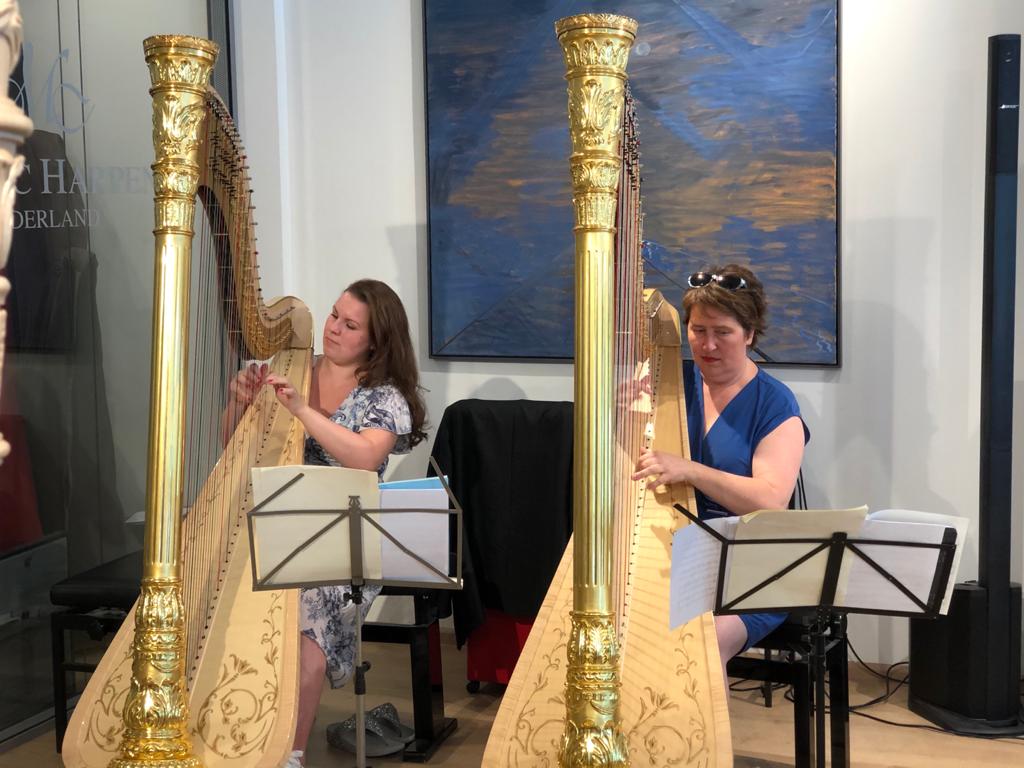
The German harpist Miriam Overlach studied at the Amsterdam Conservatory with Erika Waardenburg, graduating at both under- and postgraduate level with the highest distinction. Her competition successes include first prize in the Martine Géliot competition in 2002, twice reaching the final six at the International Harp Competition in Israel, and first prize at important Dutch music competitions such as the Sixth Dutch Harp Competition, the Dutch University Competition of the Amsterdam Grachten Festival (Canal Festival), and the Royal Concertgebouw Amsterdam's Young Soloist Prize. The Young Soloist Prize included a debut CD and numerous solo recitals, including a recital in the Concertgebouw itself. Miriam performs regularly with orchestras like the Royal Concertgebouw Orchestra, the Residentie Orchestra (the Hague), Het Gelders Orkest, the Lucerne Festival Academy Orchestra and the Gustav Mahler Youth Orchestra. She often guests with the Asko-and Schönberg- Ensemble for contemporary music, and is invited to perform at diverse European music festivals, such as the Darmstadt International Summer Music Course for contemporary music. She is also an active chamber musician: her Ensemble Lumarka has recently been invited by the concert series 'Het Debuut', which offers concerts and management to its chosen ensembles.
Miriam is currently involved in an interesting theatre project where improvisation has a big role to play. The collaboration 'Over de Bergen' between Flemish actor and writer Josse de Pauw and composer Corie van Binsbergen uses musicians from the worlds of jazz, pop and classical new music, and ends with a huge harp solo as the story reaches its conclusion. "The play is about longing - for life, for happiness and above all for freedom, so the elements of improvisation fit in well", says Miriam. "Equally, the actors' text is not improvised, and I also have some composed points during the improvisation I have to return to. The musical challenge is to see how far away I can go before I have to return to the pre-determined structure, and also to try and do something different at every performance. I think about how the show has been that night - particularly energetic, more subdued - and react to this."
"I have been doing improvisation projects regularly since 2004. There is a particularly big scene for this in Amsterdam, where I am based, and until 2006 I was in a free improvisation trio with double bass and saxophone. I do a lot of new music, and got into improvisation because I spent so much time working with composers. Contemporary composers are always looking to explore and extend the harp's range of colours and possibilities, and I thought - as a harpist, I know the instrument really well: its effects, its capacity for polyphony, its different voices. Surely I could also explore its capabilities on my own?
Any composition sets sail for new land at the time it is written, and new music is where we can experience this today. Another group I have recently become involved with is Radio Kootwijk LIVE. A lot of our work is to do with searching for new concert forms: location theatre (such as in care homes or at drug addiction support centres), but also new concepts for our shows. Younger people tend to go more to the theatre or to a dance class than to a concert, so we wanted to do something for them. We devised a bedtime concert where the audience brought their sleeping bags, and went to sleep during our performance of works by Takemitsu, Pärt, etc. At 5:20 AM we began our wake-up programme by composers like Telemann and Scarlatti, and everyone had breakfast together before leaving for work.
We also did some concerts exploring synesthesia, where we performed music in unusual locations, in order to draw more attention to the part your other senses play when you experience music.I played in sub-zero temperatures illuminated by car headlamps...
Another project was called the "Body Resonator". This was about the physicality of music, musicians and audiences:
Clever musicians have always realised that the world doesn't owe them a living just because they can play the violin nicely. You have to think about your role as an artist within the society in which you find yourself and personally I find these questions of art and society can be very creative and satisfying. For example, RKL are currently working on programmes to sell to conference venues, because we want a certain degree of practical independence. The traditional model of sponsoring music remains essential, but if you never follow anything other than the musician-takes-a-gift-of-money model, you aren't - as an artist - going to be able to enjoy aspects of freedom you can have if you support yourself. It is also artistically rewarding to consider what kind of programme will genuinely interest a corporate audience. It's a shame that it is so often assumed that such a programme should serve up something mindless everyone will have forgotten by the time their afternoon meetings begin. If you think that, you're missing the chance to discover a new audience and new musical roles."
You can find out more about Miriam's work on her website, including sound and other media clips, and details of her classical and contemporary ensembles. Ensemble Lumaka, her prize-winning flute/harp/string trio quintet, who specialise in new music and the music of the 1920s (Roussel, Jongen, etc), have just released their first CD. You can order this here from their website.