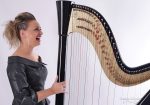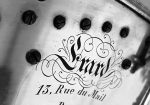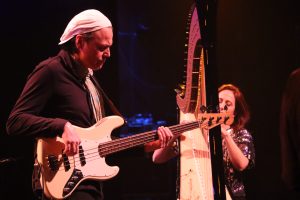
Last year, Camac's MIDI harp won the Max Matthews Prize for technological innovation at the seventh Qwartz Awards in Paris. Now Elisabeth Valletti, who performed on the MIDI harp at the prizegiving ceremony, is in the running for the eighth Awards (musical experimentation category)! She has been nominated for her eighteen "Exercices pour la Harpe MIDI", which include the Harp Haikus she performed when the MIDI harp won its prize.
VERY IMPORTANT: this prize has a public vote, which you can cast here. The closing date for voting is February 15th.
What better way to begin the new season than with a new Camac Voice providing the opening music to our commercial site, www.camac-harps.com! Elisabeth Valletti is one of the harp world’s most interesting avantgarde artists. By the early eighties, her creative path had lead her from classical studies in France, via rock and roll and jazz in the United States, to being signed by Chris Blackwell (Bob Marley’s producer) in London. Elisabeth’s resulting album, Innocenti, was described by Brian Eno as “one of the best-produced things I’ve heard in years.” Read Harpblog’s earlier portrait of Elisabeth here.
In April 2011, Camac’s MIDI concert harp was awarded the Qwartz Max Matthews Prize for technological innovation. Elisabeth was instrumental in drawing the Qwartz Awards’ attention to the MIDI harp, and she composed and premiered her ‘Harp Haikus’ for MIDI harp at the prizegiving ceremony. September's Camac Voice is an excerpt from the Harp Haikus - 'TheMosquito'.
A mosquito
Flies down my throat
Buzzing
All three Harp Haikus performed at the Qwartz Awards – The Cat, The Mosquito and The Gargoyle – are inspired by haikus written by the nineteenth-century Japanese poet IssaKobayashi.
“I have composed avant-garde music for the blue harp for many years, but this was my first work for MIDI harp”, explains Elisabeth. “When I started working with the MIDI Harp, I was thankful to have Arnaud Roy introduce me to the instrument. I began work using the Pro Tools software, and am now adding Max/MSP. To create my basic sound palette, I uploaded sounds I had processed over the course of my long work - ever since the eighties - with electric harps, FX machines and computers. Ninety percent of the sounds you hear in my pieces – whether they sound like percussion, wind or any other type of "weird" sounds – are processed sounds that originate from a harp sound. The other ten percent are conventional instruments (violins, horns) and a few vocal samples, I selected a range of sounds for each haiku that fit my idea of the piece.
“I have always been fascinated by science and I have been imagining the world of microcosmic sounds for years. Much interested in the studies about the workings of the brain, I contemplated the sounds created by the chemical and bio-electrical events in the brain when living through intense happenings which alter the conscience - like a car accident, a mystical experience, love at first sight, a poetic revelation, or a mathematical realisation. What attracted me about haikus was that they depict minute, precise moments of time. ‘The Mosquito’, for example, pinpoints the second where you realize a mosquito has flown down your throat and is still buzzing. Roland Barthe writes: “The haiku is a scratch of light, a scar into reality, engraved in time.” I fantasized time stretching, expanding through the brain sonic jungle, at the moment of the “ scratch of light, the scar into reality”. I looked inside the poet's neuronal microcosm. I listened to the storms firing into the interstices between the dendrites and the axons, riding on the neurotransmitters, escaping into the synaptic clefts. I dived deeper into the universe of the dancing/crashing quantic particles/waves.
Here is a video of 'TheCat':
Foolish cat tied up
Still crying
For love
And, 'TheGargoyle':
Like he is biting
The cold moon
The gargoyle
I have been dreaming of a MIDI concert harp since 1986 – recently I found the letter I wrote to Joël Garnier at the time, asking him to make one. I had already worked with and composed a work for Joël’s harpe à memoire, which I presented to Pierre Boulez at the IRCAM that same year. While Boulez was enthusiastic, the harpe à memoire was destined to remain a prototype: it was just too expensive to develop further then. But of course, MIDI instruments already existed, and I knew that Jakez, still very young, was already dreaming of a MIDI harp too. After all the investment and years of research that went into the MIDI harp’s creation, it was a great day when I heard he’d finally done it.
I do understand why Camac has decided not to release the instrument commercially for the time being. It’s important not to underestimate the amount of music technology know-how you need to get the most out of the harp. Arnaud Roy is a professional sound engineer, and although I had worked with electric harps and computers for a long time I found myself up at three o’clock in the morning figuring out solutions to all sorts of issues that only come into play when you start working with MIDI, rather than just amplification and non-MIDI sound processing. It is also very helpful if you are in a position to correct the bugs that crop up too. Most of the bugs will have been generated by yourself as you work – bug-creating and fixing is a normal feature of music technology.
The sound parameters are also quite unstable due to the harp’s open vibrations and specific playing technique. This volatility is very challenging when playing very exactly notated pieces – as in the case of the Harp Haikus. It can be an exciting plus when performing pieces involving improvisation, which is also an important part of my work.
I have been exploring the potential of harp sound for over twenty-five years. I like the idea of pushing the boundaries of the harp, of multiplying the richness of its musical spectrum and modifying its acoustics to create totally new sounds, of overturning romantic conceptions of what a harp should sound like. The MIDI harp throws open intoxicatingly wide doors for a sonic artist. To answer the fundamental question “but what can we do with this harp that cannot be done by a MIDI keyboard, cheaper and more easily?”, I would stress that thanks to the Camac MIDI software whose features are in perfect adequacy with the instrument, the harp-specific playing technique (glissandi ,harmonics, and the strings one can pluck, bend, shake, strike, caress, and muffle) can create sonic matter un-doable on a keyboard.
Of course, harp-specific sounds are not the only way by which you can justify the MIDI harp. Graham Fitkin took an entirely different approach in his “No Doubt” Concerto for MIDI Harp and Orchestra, working with vocal samples. But again, that piece works because it really draws attention to the fact a harp is playing, and creates surprise, even shock, that it sounds as it does. A feeling of great power emanates from the harp – the loud volume, the political anger, the huge orchestra above which the harp can be heard as clear as day – all things the listener does not expect from a harp concerto.
For all these reasons, I definitely think that the MIDI harp is a very specific instrument.”
Many thanks to Alex Rider for such an intelligent review of the 'No Doubt': Concerto for MIDI Harp and Orchestraworld premiere. I'm currently building a 'MIDI harp project page' for Harpblog, which will be a summary of our MIDI story so far. You'll find this review here, along with other comments from the No Doubt premiere and other MIDI events. There will also be some technical information and reports on the artistic projects that are being done with the harp. Once I get it all done, of course. I've set myself a deadline of before the World Harp Congress which is - really quite soon - but now I've told you all about it on the internet I'll have to do it .
Any Doubts?: Some Thoughts on Graham Fitkin’s Concerto for MIDI Harp and Orchestra, its Contexts and Reception
ALEXANDER RIDER
On Wednesday 26 January, 2011, a new concerto for MIDI harp and orchestra (Subtlitled No Doubt) by Graham Fitkin was premiered by Sioned Williams and the BBC Symphony Orchestra under Andrew Litton at London’s Maida Vale Studio 1. There was already a certain amount of ‘buzz’ surrounding this premiere, which had itself been comprehensively and energetically promoted through seminars given by Williams at the Guildhall School of Music and Drama and Trinity Laban Conservatoire of Music and Dance, as well as managing to attract broadcast interest from programmes as diverse as the BBC’s In Tune and Woman’s Hour: anyone attending this concert could hardly fail to feel a sense of occasion. The performance was an auspicious start for this young instrument, developed with huge dedication over a number of years by Jakez François and Camac Harps. The soloist, delivery and the material itself were all highly engaging and purposeful and left a very satisfying impression on the capacity-audience.
In reflecting on this work however, this concerto raises some interesting questions about the direction of the harp as a concert instrument and the performance and reception of newer art music in general: not that the harp’s direction is in doubt, nor of course the growth and diversification of contemporary music, but rather in the way both of these are things are still perceived and critically received and the way in which harpists can effectively enter the arena of contemporary music.
For those of you who read Catalan, there is an extensive article by Josep Barcons in the most recent edition of Revista Musical Catalana, about the MIDI harp and the projects focused around it at the IRCAM in Paris.
If you can't read Catalan, you can find out more about the same projects in the current edition of Harpseasons!
Another nice thing I've been able to add to the diary is a prize the MIDI harp has been given by the Qwartz Electronic Awards. This prize is called the Qwartz Max Mathews Prize, and is for what the jury considers to be the most technologically innovative instrument. Having studied a dossier describing the twenty-five years of work that led to the MIDI harp's realisation, the jury have decided that Camac's instrument represents a great step in the field of electronic stringed instruments.
We are very grateful to Elisabeth Valletti for her work compiling the dossier. At the awards ceremony, Elisabeth will also perform a work she has written for the MIDI harp. Her blue harp work - featured on Harpblog a while back - is fascinating, and we're really looking forward to hearing what she has created for the MIDI harp.
Max Mathews is considered to be the father of musical information technology. A researcher in the Bell Telephone Laboratories, he invented the first analog-to-digital converters, based on Claude Shannon's theoretical ideas. These allowed him, in 1957, to digitally record sound via computer.
The award ceremony will be on April 1st, 2011 in Paris's Theatre du Trianon.
The MIDI harp is currently residing at the IRCAM in Paris, the prestigious Institut de Recherche et Coordination Acoustique/Musique in the Centre Pompidou, as part of a major project organised by Ghislaine Petit-Volta. During the harp's three-month residency at the institute, three composers will compose new works for the instrument, and these will be premiered on April 2nd, 2011 by Ghislaine's students from the Paris Regional Conservatoire. The project will make use of all the technology now available when writing for the harp: MIDI, amplification, sound processing via Max MSP, and so on.
In this video, Jakez and Grégoire Lorieux are presenting the MIDI harp to Ghislaine's harp class. As you will quickly discover when you click on "play", this is one for the French-speakers among you, but worth the effort: it is great to have an extended discussion of the MIDI harp's technical and musical issues completely on film. For example, at the very beginning of the clip, it is discussed how notes do not always die away on the MIDI harp exactly as they do on an acoustic harp. So long as the note emits a frequency, it is picked up and interpreted by the computer, and interpreted according to how the computer is programmed at that time. This can have a significant impact on a harpist's technique, such as by demanding that you play with much more damping.
We are still working on getting permission to broadcast a complete recording of Graham Fitkin's MIDI harp concerto outside the UK, but this short recording has been released by the BBC on YouTube, to whet your appetite for the whole thing!
There's a friendly tie of some sort between music and eating
Thomas Hardy
On my old camera, which I unfortunately recently smashed up beyond repair, I had a collection of photos of lovely food I have eaten in the name of working hard for Camac Harps. One picture, of some particularly delicious beef consumed in San Escorial in 2009, has survived in a Harpblog post about Deborah Henson-Conant's Burnt Food Museum, but other than that you will either have to take my word for it, or come to dinner with us one day after an event.