The distinguished harpist-composer Benoît Wery has just released a new
words-music CD, with flautist Philippe Pierlot, and one of France's most famous
actors: Marie Christine Barrault. April's Camac Voice is an extract from the
final track on this album of French poetry and music: L’Isle de la Fée for
harp and narrator, by Benoît Wery, based on the tale 'The Island of the Fay' by
Edgar Allen Poe.
Benoît Wery is much in demand both as a performer and composer, in and
beyond the harp world. He has particularly made a name for himself as a
champion of French music. He was awarded five diapasons for his CD
"musique française avec harpe" (Chant de Linos CL0946), and his
discography also includes a disc of French violin and harp music (CL1061) with Jean-Pierre Wallez, and one of French flute,
bassoon and harp music (REM 311283).
The clichéd image of the harp and harpists will be
so familiar to most of Harpblog's readers that I won't describe it again. It's
such a cliché that even "I want to dispell the cliché of the beautiful
girl playing the harp etc. etc." has become clichéd.
Clichés are a funny mixture. Dulled by over-use,
nonetheless they wouldn't exist without some basis in truth. And those who find
themselves, like harpists, in particularly cliché-strewn fields, can't just
throw them aside either. Whether you want to make use of them - to boost your
wedding business, for example - or get away from them, they're hard to
ignore.
The German pop harpist and singer (all her
songs are in English), MarieMarie,
knows about cliché. Her own music is “folctronic”, fusing elements of
electronic music, like techno and dubstep, with folk, acoustic instruments and
original, thoughtful lyrics. It’s music which is very much her own, for all
that isn't as self-evident as it sounds. "The whole reason I started to
write songs with the harp was to get away from cliché", she explains.
"I started with a standard rock band combination. There's nothing wrong
with rock if that's where you find yourself as an artist. But when you're
desparate to escape a cliché, simply taking the most opposite direction you can
think of isn't, in itself, any better. After a while I thought, this is no good
- I don't like harp clichés, but equally I feel like I'm forcing the harp to
sound not like a harp for artificial reasons. I might
not be acting like a harpist, but I still feel like I'm pretending to be
someone else."
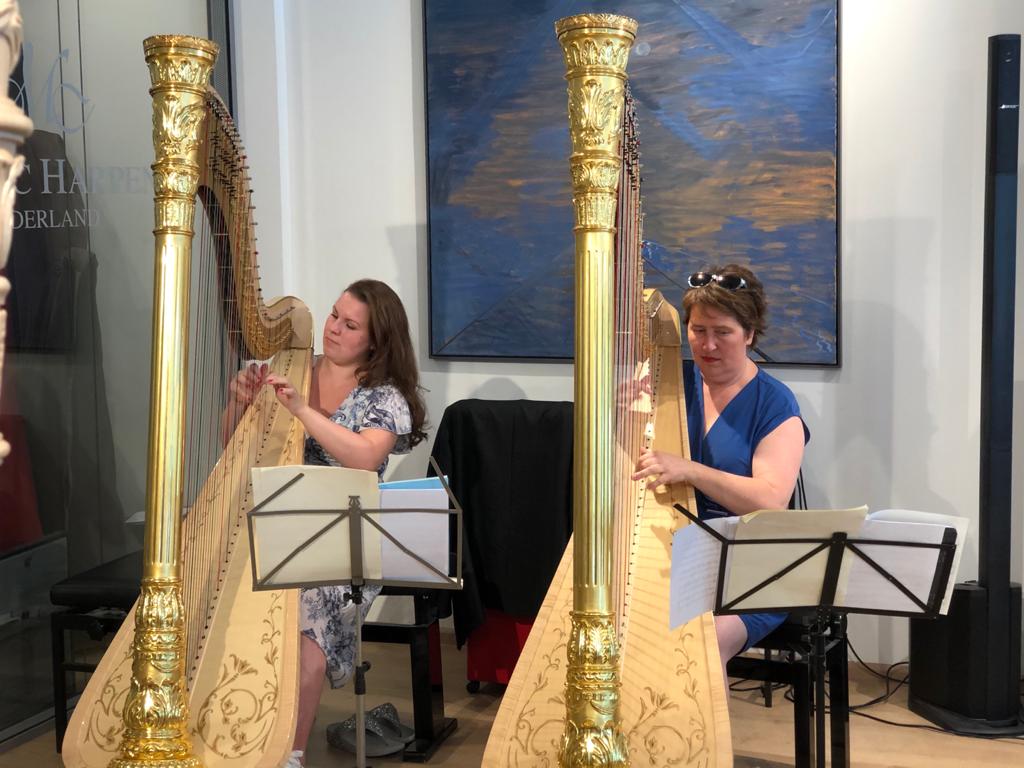
The Camac Voice of February is one of the artists who recently performed at Camac Ibérica’s birthday party in Madrid: François Pernel. The extract now playing on camac-harps.com is part of François’s own arrangement of J S Bach’s first cello Suite. The cello suites are tricky to bring off on the harp – perhaps because of the very different colour of bowed cello bass notes – and it’s impressive to hear this one, the most famous, so successful on the lever harp. If you like that, check out François’s SoundCloud page, where you'll find everything from a Vivaldi-based classical waltz mix, to "Irish groove", "Celtic Breton jazz", and "Rachman'hip'hop".
Despite the sound of its name, traditional music is an exceptionally creative medium, adapting and adopting whatever musical styles it finds and likes. In the lever harp world alone, you’ll find so-called “Celtic” music (itself native to at least five different countries and traditions) married to classical, jazz, world music, rock, pop, electronica and the avant-garde. With its spirit of constant discovery, this music is anything but entombed in aspic, and proves that tradition is as much a question of individual talent as anything else.
François Pernel is one of the lever harp’s most individual talents. Composer, arranger, performer and teacher, his music is distinguished by a particularly skilful appropriation of diverse influences. He has released more than a dozen albums - which you can order here, or download as MP3s - from his composition ‘Gnossienne’ in homage to Eric Satie, to his album ‘Harpe Corps’, on which all the tracks feature amplification and sound processing in one way or another.
When you are a student, it often feels like you must win a big competition in order to have a career. Of course, a big win is a fantastic achievement that should be celebrated, and the competition experience is invaluable in many different ways. But it is not a win, itself, that makes a career. Ask yourself who came second or third in a big harp competition even three years ago. Do you know, off the top of your head? Can you even tell me who won, if you go a bit further back, perhaps six years? If it wasn't you or your lover, I bet you have to look it up. What you will probably be able to do, however, is cite the past and current activities of famous harpists. Maybe you know that Isabelle Moretti teaches at the Paris Conservatoire, is one of the most famous soloists in the world and released a CD with Dame Felicity Lott not so long ago. Your library might full of recordings by Nicanor Zabeleta, Marisa Robles, Marielle Nordmann, or you are trying to get onto a summer course with Susann McDonald. Maybe you are aware that Xavier de Maistre recently did a Venetian baroque CD; that Anneleen Lenaerts now plays with the Vienna Philharmonic; that Catrin Finch is releasing her second album on Deutsche Grammophon. You could be a fan of Isabelle Perrin, Remy van Kesteren or Maria Luisa Rayan-Forero. I could go on and on, and I am a bit, but my point is that some of these artists have a first prize somewhere about their CV; some don’t; and in any case it is not their first prize that you think of first, if at all. Careers are made by being consistently very good, over years. It does not feel like it when you have just got the gut-wrenching news that someone else has won the competition you have worked so hard on, but it is your long game that will make you in the end.
Our Camac Voice for November is one of the young harpists whose work I follow with the most interest. Harpblog has sung the French-Canadian harpist Valérie Milot's praises on several occasions. From her success in the Cité des Arts competition 2008, to her performance at the 2011Camac Festival and her excellentrecordingprojects, her career is going from strength to strength. It is deservedly recognised by the wider musical establishment, always a killer nut for harpists to crack. In 2009, Valérie was named Young Soloist of the year by the Radios Francophones Publiques group, as well as Discovery of the Year at the Quebec Music Council's Opus Awards. In the same year, Valérie also won the Louis-Philippe-Poisson Performing Arts Award by the Grands Prix Culturels 2009 of Trois-Rivières, and became the Révélation Radio-Canada Musique for the year 2009-2010. Her 2012 diary is full of solo, chamber and concerto engagements, and she regularly releases discs on the Analekta label which always stand out because of their genuine creativity, musical integrity and unfailing good taste - a balance which is a lot harder consistently to pull off than it sounds.
While we were at the Ksenia Erdely International Competition, we met Carolyn Lund. Carolyn not only reached the semifinals of a very demanding competition, but did so while teaching fifty harp students a day. Yes, a day, in six group classes, with additional tuition in the evenings as well. That's a pretty amazing achievement, and what Carolyn does is also a pretty amazing job. Hear some of the results now, on camac-harps.com!
Carolyn is the artistic director of the Urban Youth Harp Ensemble, which is a harp education programme for disadvantaged youth in Atlanta, Georgia USA. It was established twelve years ago by Elisabeth Remy Johnson, principal harpist of the Atlanta Symphony Orchestra, and Roselyn Lewis, a longtime Atlanta public schools music teacher known for exposing students to opera and African drums. Carolyn was appointed artistic director when Elisabeth retired from the project, while Roselyn remains at the helm preparing the grant applications that have always been the programme's entire source of funding.
"I see fifty students every day, divided into six classes, plus after-school tuition", Carolyn explains. "They can opt for harp class instead of band or chorus class, and while it is not possible to give fifty individual lessons, the idea is that the daily classes help them to advance quickly. We have fifteen harps, because none of the students are in a position to have their own harps at home, so all practice is done at school.
The students learn to play the harp, but also to read music and develop their general musicianship. Of course, most of them will not go on to be professional harpists, although in fact the programme's first student, Mason Morton, is currently now doing his performance doctorate with Ann Hobson Pilot in Boston - and he has achieved this through scholarships all the way, no loans at all. But whether students want to pursue the harp long-term or not, we have an honours group made up of the best students, and they go out and do professional gigs.
Mason Morton (at the harp) comes back to visit the current class
Deborah Henson-Conant needs little introduction to the harp world. She was one of Harpblog's first ever interview subjects, and we are very proud of how we have been able to work with her, developing our range of electric lever harps. Our DHC Blue Light, named after her, is the most recent of these (you can read Deborah's own account of her association with Camac here).
But that's enough about us. Deborah is currently playing an amazing tour, the like of which has never happened to the harp world before. Deborah is...on tour with the legendary rock guitarist Steve Vai. In the rock world, Vai is known both as one of the ultimate 'shredders' (think 'lots of notes') and as one of the most sophisticated rock musicians. He’s also unique in being a rock starinstrumentalist. In her blog "How to Enjoy a Steve Vai show if you’re not a Rock Music Fan," Deborah described him thus: "Think Pagannini in the 21st century with an electric guitar and you start to get the picture."
There is not much harp (yet) in rock, although there are some noble exceptions, like Lena Woods, another artist we love. It is music Deborah always wanted to explore: "I’ve always believed the harp has an important voice for rock music - and I’ve explored that voice, using distortion and altered harp techniques, in my one-woman shows and in the music I write for harp solo and orchestra. but I don’t come from a rock background and to find that voice for the harp I’ve always known I’d need to go into the belly of the beast, as it were – to take the harp right inside rock. Though I had no idea how I’d do that."
"About a year ago I got an email with the subject-header 'Steve Vai here.' It showed up in my inbox along with a moving invitation from the heir to a Saudi fortune, and the exciting results of a lottery in which I’d won over a million dollars."...Deborah gives an entertaining account of how she met Steve Vai in her extensive blog about the tour, "the rock harp diaries".
Check out Deborah's solo at 1'39!
I'll never forget the time I went to a shared concert by the conservatoire in question's classical and jazz departments. After a while, the classical professor leading the project got up and said to one of the jazz students "so, how did you cope, working with such complicated music for the first time?". It takes just as long to become a good jazz musician as it does to become a good classical one, and the same is true of rock. Moreover, Deborah isn't working with a normal rock musician. She's working with one of the most brilliant virtuosi that genre has ever seen.
Deborah therefore undertook a huge amount of preparation. From taking a twelve-week online course in Steve Vai's guitar techniques to transforming her lever technique to accomodate super-fast changes (and using a whammy pedal to get through some chromatic shifts); from coming up with memorisation tricks to buying an iPad, you can read all about it in her diaries. Deborah's track now playing on camac-harps.com is from this preparatory period, as she was experimenting with a wah wah pedal.
The tour is called The Story of Light
Reading Deborah's blog, I've realised that one of the best things about blogging in general is that it happens in real time. The rock harp diaries is not a PR exercise presenting the final triumphant results: it's a real behind-the-scenes, work-in-progress account of Deborah, herself already a world-famous harpist who was signed to a jazz label in the 90s, and who then received a Grammy Nomination for her classical crossover work with symphony in the last decade, now plunging into completely new musical territory, and basically starting over from scratch. That makes it even more exciting to read, for we don't know the outcome. Nor does Deborah know, and the honesty with which she chronicles her adventures is courageous and hugely encouraging to read. You see, it's not just you that sometimes has a hard time in the practice room. Everyone, including the biggest stars, knows how you feel.
"I keep wishing my jazz-intensive students could see me experiencing this kind of shell-shocked disconnect, because it’s exactly what I see them experience when they first begin studying with me – a sense of getting nowhere, flailing, demoralized, idiocy – that sense of “My God! Did I ever actually think I was a functioning musician???”
All of which I am experiencing.
When I see my students experiencing it, I know it’s just their brain shifting from an old way of knowing music to a new way, and that the deep sense of disorientation and uncoordination is part of making that shift. I know that the things that seem obvious to me, are often completely invisible to them until the structures finally become clear in their minds.
Until then, it’s like trying to build a box out of fog."
As the tour draws nearer, you read about the final rehearsals, find out what's most essential to take on a tour bus, and celebrate at least two personal victories for Deborah - one, finding a real ladies' lavatory, and two, the box emerging out of the fog. As the show progresses, Deborah's role in it is even growing - now with her own solo, and duets with the bass player and guitarist.
"WEEPING CHINA DOLL is one of the most challenging pieces from Steve’s new album, The Story of Light. Simply to remember the lever changes on this piece I took a workshop in memorization (no joke!).
The piece is epic and cinematic, and my part is very much like an orchestral harp part: broad sweeps, coloristic, with sounds that range from bell-like harp arpeggios to sounds like a Koto.
To execute some of the harmonic changes in this piece I use a Whammy pedal to shift my whole instrument down a half-step (to make that shift ‘by hand’ on my lever-harp you’d need to change 32-levers). So I worked like crazy on this piece with my coach, Marta Cook, and when we rehearsed it today, I poured all of that into it.
And when we were done, Steve put his guitar down, walked across the stage and hugged me.
June’s Camac Voice is a clip from a wonderful transcription of Shostakovich’s Prelude and fugue no. 4. It has been recorded by Remy van Kesteren, and forms part of his debut CD, ‘Remy’.
It is not easy to pursue a top-flight performing career and run an exceptional annual festival, but Remy has pulled it off. From its beginnings in 2010, the Dutch Harp Festival has proved itself to be one of the best events in the harp world calendar; meanwhile, Remy has a busy concert schedule, including a unique harp/violin/saxophone ensemble. He even manages regularly to update a thoughtful, English-language blog, which you can read via his website.
All of Remy’s activities distinguish themselves through a magical elixir of fine, tasteful and charismatic musicianship, very good communication skills, exemplary professionalism, and powerful personal integrity. This combination sounds easier to take for granted than it is. But it is exceptional. If it weren’t, we would all be doing it.
The early harp specialist Véronique Musson-Gonneaud has just released a new album: “Pour un plaisir: Intabulations by Antonio de Cabezón and his contemporaries" (Brilliant Classics 94351). It’s an atmospheric window on the dignified music of the Renaissance Spanish court – Antonio de Cabezón, Juan de de Cabezón, Hernando de Cabezón, Francisco Fernández Palero, an original piece for the harp by Alonso Mudarra (ironically, his more-performed Fantasia is originally for vihuela), and two anonymous works, all played by Véronique on Renaissance double harp. Hear an extract now on camac-harps.com!
February’s Camac Voice has been recorded by none other than the winner of November’s Cité des Arts competition: Maureen Thiébaut. It is the opening of the Sonata K208 by Scarlatti.
Maureen Thiébaut
Maureen Thiébaut began the harp in 1996. In 2005, she joined the Conservatoire à Rayonnement Régional de Paris (CRR), where she studied with Ghislaine Petit-Volta until 2009. Having received her Diplôme d'Etudes Musicales (DEM) with a "très bien" credit, she entered Isabelle Moretti's class at the Conservatoire National Supérieur de Paris (CNSMDP). A propos - the CRR is one of the harp world’s best-kept secrets. Its first undergraduate degree - the DEM that Maureen took - qualifies you to then take the entrance audition for the undergraduate course at the CNSMDP. This can be very handy to remember if you cannot immediately apply to the CNSM because you do not speak French, and / or haven’t done solfège: you have to pass exams in both before you may proceed to the harp audition. The results speak for themselves: of the seven candidates to make the CNSM audition’s final in 2010, five with Ghislaine’s students from the CRR. Harpblog has covered this subject before, in “Studying in...Paris”.
Back to Maureen: as well as winning first prize and the Louise Charpentier prize in the Cité des Arts of Paris competition in November 2011, Maureen also won third prize and the "coup de coeur" prize at the Martine Géliot International Competition in 2008. She is principal harpist with the Manifesto Orchestra, and has also worked with the Paris Opera (2011), the Orchestre des Siècles (2010), and the Orchestre Prométhée (2008). She performs regular solo recitals, and teaches at the Animathèque MJC in Sceaux.
The number of harp competitions has exploded in recent years, meaning that harp students prepare and focus on them more than ever before. As sponsors, we also attend more competitions than ever before, and - more than ever before - one notices the difference between candidates who have approached a competition wisely, and those who haven’t. But what is this “wisely”? Perceptively, Maureen points out that doing a competition is not like filling out a form, either correctly or incorrectly: “I would never presume to lecture harpists on how exactly to win a competition, because each person prepares in their own way, and has his own reasons for doing a competition.”
Despite the variety in individual competition preparation and reasons for doing it, nonetheless it is clear that you must prepare carefully, and you do have to have reasons. Fact: if you aren’t ready, you’ll not win a serious competition. Even if nobody else as good as you turns up, I’ve never met a harp jury that forgives insufficient preparation, and prizes can be and are withheld all the time. In an article by Adrienne Bridgewater in the January / February 2010 edition of Harp Column Magazine, her entire interviewed panel of competition winners emphasise their preparation: “Our panel said they began anywhere from as soon as the repertoire list was published to seven months before the competition. ‘At the last minute’ was not an answer we heard from the group.” Sam Karlinski, who writes a detailed and helpful blog about competition preparation, offers a year’s timeline in the same article. For the biggest competitions, the repertoire lists usually come out two years in advance, and there is a reason why they do.
January’s Camac voice is the exhilarating finale to a substantial work for harp quartet, commissioned and performed by the British ensemble 4 Girls 4 Harps. This work, ‘Saraswati’ by Edward Longstaff, is inspired by Saraswati the Hindu goddess of music (as well as of knowledge, art, science and technology). She is usually depicted with four arms, portrayed here by the four harp parts. For this recording, 4 Girls 4 Harps added a tabla line, from Sanju Sahai, to emphasise the work’s powerful rhythmic quality as well as its Indian influences.
Harpblog posted an article about 4G4H nearly two years ago, in February 2010. You can read about the group’s beginnings here. As they have scaled the ranks from student quartet to a highly polished professional ensemble, they have remained true to their wish significantly to expand the harp quartet repertoire - also for other harpists.