Some many of you will remember the smash hit, worldwide success of CamacCam, our video blogging live from the Vancouver World Harp Congress in 2011. Harpblog is now back at the movies with a video report from our very busy and enjoyable Camac festival in Geneva!
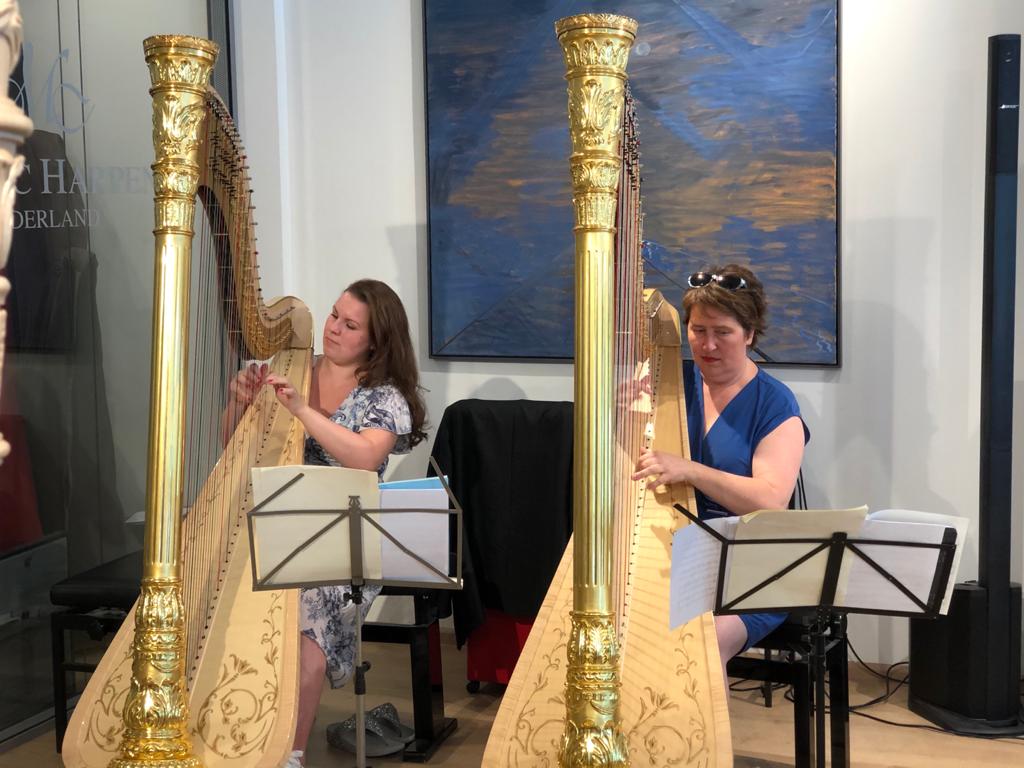
The festival began in style with an excellent concert of harp chamber music. The three duos who are Ghislaine Petit-Volta and Jean-Marc Volta, Isabelle Moretti and Magali Mosnier, and Sophie and Marie Hallynck, offered us a programme that ranged from introducing us to new repertoire (such as a Tôn-Thất Tiết world premiere for harp, clarinet and bass clarinet), to being a chance to hear flute and harp music at its very best. While the harp chamber repertoire contains some of the best music ever written for the instrument, its relatively small size is not without its challenges. New music, and the opportunity to discover how stunning and rich less usual combinations (like harp and cello) can be, are both vital contributions to the development of our chamber music - and equally, it's both inspiring and humbling to hear a familiar work like the Saint-Saëns Fantasie Op.124 played so well that it is like hearing it for the very first time. I was reminded, not before time, that to think "the Saint-Saëns will be OK, I'll just run through the solo demisemiquavers an hour before the concert" is to have lost your way amid this beautiful music.
Perhaps you could go so far as to say that these two forms of musical surprise and delight - the one coming from new music or musical styles you haven't experienced so much before, the other from hearing classics performed at their highest level - are hallmarks of the festival. We are very lucky that the best artists in their fields consent to come and perform for us. In Geneva, over the course of just three days, it was possible to hear everything from the aforementioned duos to Petra van der Heide, principal harp with the Royal Concertgebouw Amsterdam, show us how it's done with a solo programme of Glinka, Scarlatti and Grandjany. Beyond the concert harp, Mary Macmaster and Patsy Seddon performed and gave a workshop as the Sileas duo. Sileas were one of the first groups to give the harp a front seat in the exceptionally lively and creative contemporary Scottish electro-folk scene. Especially if you're not Scottish - and not many of us were, at the festival in Geneva - to hear and talk with them leaves you feeling that a door has opened onto an intriguing new musical landscape.
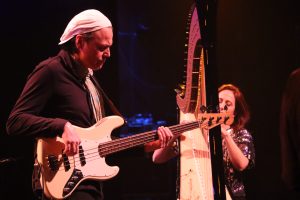
We've been fans of Tara Minton ever since Jakez discovered her debut CD, so we were thrilled to be able to hear the Tara Minton Trio live for the first time. With Elias Gargallo on drums and Leonardo Caltabiano on bass, Tara wowed us with her soulful, original songs. This is not a group just using the electric harp as a novelty item: this is both wonderful songwriting and great harp playing. If you haven't come across Tara yet, rush to iTunes and download her music.
The festival's final day was entirely dedicated to the music of Bernard Andrès, a composer many harpists can say they have grown up with, and who has composed over fifty works for all types of harps, and instrumental combinations with harp. His prolific contribution to our repertoire is both extremely useful to harpists of all levels, and also worthy of in-depth study, and we are very grateful to Bernard for coming to the whole festival, and working intensively with the students.
We are particularly grateful to the local students and professors themselves, and particularly to Isabelle Martin-Achard, without whom the festival could not have taken place at all! It is their engagement that has created another Camac festival hallmark: a rich dialogue between international stars and regional centres. I always learn a lot from this, and I hope I'm not the only one. Perhaps it is such a fruitful exchange because it is at the heart of music itself, in real terms. You can admire a star on a billboard, CD or from your seat at the back of the concert hall, but as a musician yourself you gain immensely from also being able to meet and work with them. Music and all forms of culture also profit from broad horizons, such as the perspectives you gain by travelling. But most people cannot travel all the time, and this why regional events are important. Thank you very much to the harpists and general public of Geneva for welcoming us so warmly. I don't know where the next Camac festival will be yet, but...watch this space!


Comments