In 2000, Jakez reworked our lever harp catalogue to make it clearer, particularly with regard to the names of the harps. Models before this time can still be a source of confusion. The harps were worked on a lot, which resulted better harps, but also in a rather complicated list of models often with the same strings and ranges, yet different.
To help with any confusion particularly regarding second-hand models from our earlier ranges, David Rescher of the Harfengalerie Camac Berlin has written a German-language explanation of the background to the present-day Mélusine and Korrigan, plus a summary of our current range, in response to questions on the German harp site harfenforum.de. I've made an English version for Harpblog. Never do any work someone else has already done, better than you would.
The Morgane, with its thirty-four strings, was the first larger lever harp made by Camac, in the 1970s (prior to this, we manufactured a leverless Bardic harp with a four-cornered soundboard and in quasi-Guinness style. It was also available in kit form, and very popular throughout the 1970s). The Morgane was built to be strung in nylon (A01 – D26), with bass wires (C27 – C34), offered with a choice of flat feet or taller legs, and a four-cornered soundbox. The Morgane remained in production until 2001.
At the end of the 1970s, Camac added their Mélusine model to their range. This harp had 36 strings, 2 more than the Morgane, in the bass (H35 and A36). It was also strung with nylon and wires and had a similar four-cornered soundbox. The Mélusine came into being following requests from Breton harpers, who wanted a greater bass range.
The Mélusine de Concert, developed in the 1980s, had a round and bigger soundbox, and a correspondingly bigger sound. The first Concert Mélusines still had a carbon fibre soundboard, with which Camac’s founder, Joël Garnier, had been experimenting in this decade.
In the middle of the 1980s, Camac released their Korrigan model, firstly with 34 and subsequently with 36 strings, both with four-cornered soundboxes. The Korrigan was originally offered with the following stringing: A01 – C06 in nylon, H07 – D26 in gut (either in concert harp gauge or in “light” gauge), C27 – C34 in wires. The Korrigan always had a different basic structure to the Morgane and Mélusine: namely, a higher and more tapered neck above the bass register.
In response to requests from harpists for a gut-strung lever harp with a bigger sound than the Korrigan, Joël Garnier developed the Jumbo at the end of the 1980s. It had a thicker soundboard, and round soundbox. Like the Korrigan 36, it had 36 strings, but with a different string length and higher tension than on the Korrigan.
On the other hand, other customers wanted a nylon-strung harp with the Korrigan’s slender look. Joël Garnier therefore developed a modified Korrigan model in the early 1990s, with a soundboard built to accommodate nylon strings, and a neck designed to accommodate the longer length of these strings. Because of this, the neck looked straighter, particularly in the middle register, than that of the Korrigan, but is pulled just as high at the end. This model was offered firstly with 34 and then with 36 strings: A01 – D26 in nylon, and C27 – C34 / A36 in wires.
The model names were beginning to be a source of too much confusion, so when Jakez François took over the company following Joël’s death in the autumn of the year 2000, he overhauled the entire lever harp range. He made the Korrigan a gut-strung harp only (in concert or light gauge), the Mélusine a nylon-strung harp only (in standard or heavy gauge). The structure and soundboard for both models were also developed to incorporate 38-string models. You will find more detailed information about the stringing of our current models on our website, and in our catalogue.
The original Electroharp prototype, now in the National Museum of Scotland
Deborah Henson-Conant and her DHC Blue Light (it may be called Blue Light, but the actual lights are not included...it's called Light because it's very light...)
The E C Llanera is also a real harp
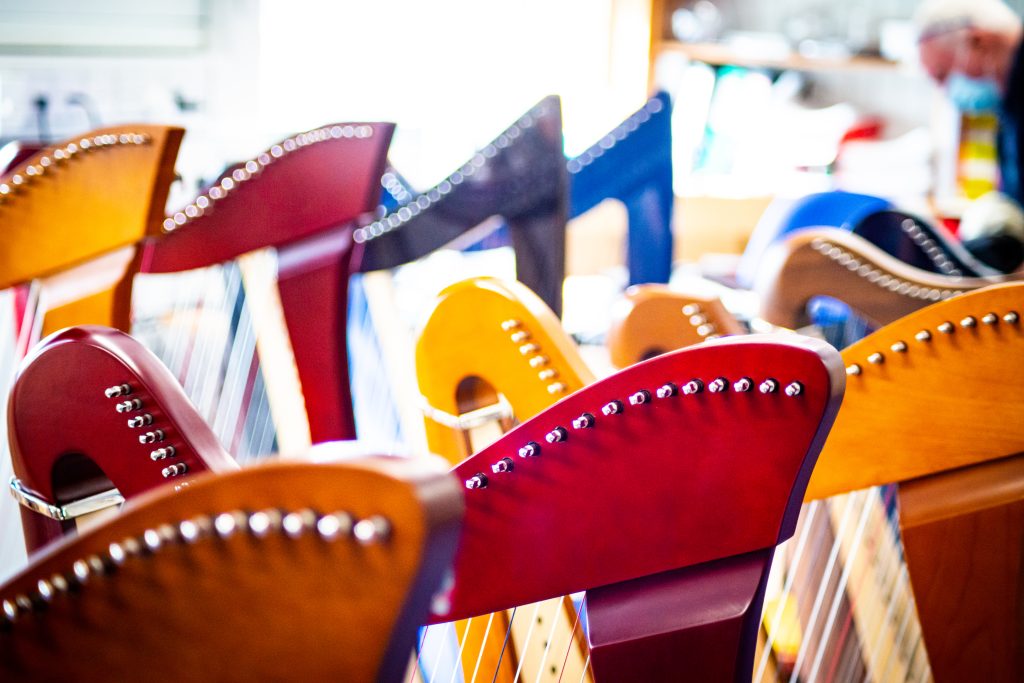
Alongside the Mélusine and Korrigan, Camac now offers eleven lever harp models: the Bardic 22, Bardic 27, Telenn, Hermine, Mélusine de Concert, Mademoiselle, Stivell, Aziliz, Janet, E C Llanera and the new electro-accoustic Telenn Kadiou. There are also four electric lever models: the EH30 (the ‘Baby Blue’), EH36 (‘Electroharp’), and DHC Blue Lights 32 and 36. The individual models vary not only optically, but in how they are built and strung and therefore they also offer a broad range in terms of type of sound and how they feel to play.
The Telenn Kadiou is another recent collaboration with an artist - Dominig Bouchaud


Comments