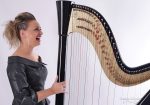
The early harp specialist Véronique Musson-Gonneaud has just released a new album: “Pour un plaisir: Intabulations by Antonio de Cabezón and his contemporaries" (Brilliant Classics 94351). It’s an atmospheric window on the dignified music of the Renaissance Spanish court – Antonio de Cabezón, Juan de de Cabezón, Hernando de Cabezón, Francisco Fernández Palero, an original piece for the harp by Alonso Mudarra (ironically, his more-performed Fantasia is originally for vihuela), and two anonymous works, all played by Véronique on Renaissance double harp. Hear an extract now on camac-harps.com!
I love this recording because you feel you’re sitting on a stately throne having your portrait done by Velázquez: or, to put it more seriously, any music from outside your own nearby sphere is like getting in an amazing travelling machine, catapulting your imagination through time and space. But my interest was also particularly caught because Véronique’s project engages with the issue constantly burning at the heart of early music: authenticity, and to what extent it is possible and / or useful.
“The central paradox of early music studies is that you are doing your best to discover the past, yet simultaneously you must accept that you will never know, for sure, its every detail. Sources are often fragmentary; scores do not contain all the indications necessary for their interpretation; and at the end of the day, music is a living art form. It has to be played and heard by living human beings, or it is only silent dots on a page. Literally and philosophically, it’s governed by time.
For early music specialists, the question is how to live with this paradox. There are two common tendencies. On the one hand, there are the purists, who want you to do nothing not permitted by a source. Of course, there are arguments for this position. But if you pursue authenticity at any price, it is possible to end up with archaeology. First and foremost, music is a living, sensitive art.
On the other hand, if you just play however you feel like, your end result may perhaps be less expressive, not more. If you are a performer, your role in music is re-creative, rather than directly creative; the spark is from your own sensibility in relation to everything you are able to find out about your chosen repertoire. If you pay no attention to the latter, it may be that the music’s spirit is absent from, or even betrayed by, your interpretation.
To find a just balance between these two poles of authenticity and freedom, is for me the central issue for the performer. It is a difficult position, sometimes even depressing, but it is also fruitful, very constructive.
All traditions and styles develop their own rules, which as with languages provide you with tools to express the music in ways your audience can also understand. Music needs a certain internal logic if it is to be shared with others. The human brain uses pattern and design in order to comprehend. That’s why we can’t all just babble to each other in individual, made-up languages. So when I study early music, I do so rigorously, not because I think I’m going to be right, but to try and uncover enough of its logic, its language Then I can give voice to it again in the here and now. The constraints of style and history are actually liberating, in the end. You learn a new language and that unlocks new creative and expressive resources.
As a teenager in the 1980s, the first early work I ever played was the “Pavana con su glosa” on my pedal harp, in Zabaleta’s edition. This is a fine edition, reflecting what Zabaleta knew about this music at the time, but few would of playing it like this today. That this edition is subject to fashion exemplifies how there is never absolute truth in music. The paradox is that you have to hunt the truth in order to arrive at a just interpretation, but to claim to have found it would be crossing the line. You have to stay humble, asking questions, and accept that what you play today might have gone somewhat out of date tomorrow. This is the basis of all artistic engagement, and is also where we can work most productively – because we are aware of the need constantly to interrogate what we are doing in the here and now.
I wanted to tackle this music for two reasons. Firstly, it is very beautiful and has always touched me greatly. Secondly, it is supposedly written for the harp. Both these two reasons turned out to be problematic, which is both troubling and inspiring at the same time.
Before I started this recording project, I knew I was never going to unlock the perfect truth about the late-Renaissance harp in Spain. To talk firstly about the instruments themselves, the period is full of unanswered questions, one of which being what the harps of the time were like. Probably the major composers of the period required a chromatic harp, but various solutions – single and double harps, crossed or parallel-strung – were built in Spain in the 16th and 17th centuries. In any case, you can’t say there is a single, definitive Renaissance harp.
I weighed up what I knew and created an argument for my choice, really – it remains a choice, rather than a fact. I acquired a double harp with two parallel rows of strings built by Eric Kleinmann in 2006, after a rare instrument preserved in Bologna, and the wonderful sound of this harp drove my decision to record this music, even though this is considered more an Italian than a Spanish instrument, and also presented significant technical challenges.
I could have used a triple harp from the beginning of the 17th century (also called “arpa doppia”), or an arpa de dos órdones as is available to us today. These are inspired by instruments from the second half of the 17th century and later, and they also sound later to me. I wanted to use the double harp because its sound seemed to fit perfectly with the repertoire I wanted to record. Also, the Spanish arpa de dos órdenes in the form we know now comes mostly from the 18th century, and we cannot be sure it had even started to be used in the 1500s. Certainly it did not become widespread until the following centuries. The arpa doppia enjoyed its greatest success in Naples – which was a Spanish kingdom until 1714.
The arpa doppia I have used for this recording has two rows of parallel strings: one is tuned diatonically, and the other to flats and sharps. The problem is that on this harp, the two tuning systems invert at middle C, to allow each hand to play what will be the most important notes for it on the outside row. As a result, in music of this period, it is very difficult to play: the left hand cannot go up into the treble register, and the right hand cannot play the bass. This CD is the first recording done on a double harp: at the beginning, I was not at all sure if these works were playable on this harp at all. Especially the pieces with five voices!
These difficulties were nonetheless constructive in two ways. Firstly, I came to understand better why a double harp must be tuned the way it does (which was not at all obvious to me at first), and I was also better able to consider the issues surrounding my instrument’s construction (as I say, a modern copy). There were some problems with the basic string plan. You have to “let the plaster dry”, as we say in French, put up with initial problems. For example, in the course of playing I realised there were problems with the bass sound, which came. above all from an error in the string plan: one string too far to one side forced me to perform some acrobatics. I would probably never have noticed this, had I not been playing repertoire, considered to be practically impossible on this type of harp. It is not impossible at all but one should always remember that our work should also always be a dialogue with instrument makers. We often consider, when we order an instrument, that this instrument will be comparable to an historical instrument – but this is naieve! In fact the instrument makers are exactly like us: they are interpreters, who construct what they understand to be the case at a given moment in time. Organology - the science of musical instruments – and musicology benefit from the musician’s experiments as much as the musician benefits from their work.
The choice of an instrument is therefore riddled with questions, but that’s not all! The choice of repertoire is just as problematic.
While the editors of Cabezón and his contemporaries published the works as interchangeably for keyboard, harp or vihuela, it is not sure if all works were for all these instruments. All the repertoire on my CD was most likely not really destined for harp or vihuela at all, but instead for keyboard instruments. The subtitle “para tecla, arpa o vihuela” stemmed in fact from a theoretical, idealistic idea of the first of these editors, Luys Venegas de Henestrosa (1557), who was looking to unify the notation of all polyphonic instruments into a common tablature system. The indication was repeated by all his successors, probably because they wanted to publicise their scores as much as possible (especially Hernando de Cabezón, who was the principal editor of his father’s works in 1578).
With some pieces, I thought at once they would sound excellent on the harp. Others were more difficult, because when I was playing them all I could really hear was an organ, and of course that made me hesitant about recording them. For example, the Differencias sobre el canto Ilano del Cabellero by Antonio de Cabezón – an extract of which I’ve chosen for camac-harps.com – was one of the most problematic, and eventually surprising, pieces for me.
It has been very interesting to experiment with this repertoire: its very flexibility has dissolved many of my preconceptions, and given me new ideas about sound, playing, and notation.
For example: as I worked all the way through my project, well beyond the Differencias sobre el Caballero, and despite my preconceptions, my harp revealed itself to me so masterfully. It revealed its identity by means of a sound and notation patterns I would never have imagined could suit it. The essential question, then, is not to know if such-and-such a piece was written for the harp or not, or for which kind of harp, but rather to find, to “invent” (in the etymological sense of the word), a repertoire for this instrument, which one hopes is closer to the harp than other works around at the time. All this is nothing other than creativity, namely creativity both entirely contemporary, and indissolubly tied to research and knowledge about our heritage.
For too long, we have demanded the performer be above all an entirely faithful executor, and if the little plus we call “musicality” appeared on top, we have considered that signifies a “gift”, an extraordinary virtue: indescribable, ineffable. The early music movement offered a different way of thinking, and paved the way to seeing the musician in a more complex, more artistic light. This is perhaps the movement’s greatest merit, beyond the rediscovery of forgotten repertoire.
It is not always easy to defend this position today. There are now three or four generations of early music specialists, and the temptation is do what is easiest, and to forget the doubts and research that were originally at the heart of the early music revival. The new approach is sometimes practised thoughtlessly: if you are content just to follow your early music teachers, that’s no good either.
You’ve got to remember that, when the early music revival really began to influence the rest of the classical music scene in the 1980s, it was a violent shift in performance practice. It forced musicians to be much more active, much more personally responsible. There is still a long way to go in terms of giving the musician his responsibility back in this way, but great strides have already been made over the last forty years. The early music approach, which was revolutionary at the time, is widely accepted today. It has also influenced music teaching, and amateur practice.
Essentially, the early music revival has given the musician a place, a position, or maybe we should say possibilities as a performer not so readily available to him before. It has had a global impact on music from any era, not just Baroque and earlier. For me, this is one of the most powerful reasons to study early music.”
In the same spirit as her Cabezón disc, Véronique has published Medieval music adapted for the lever harp, available from the Camac online boutique!


Comments