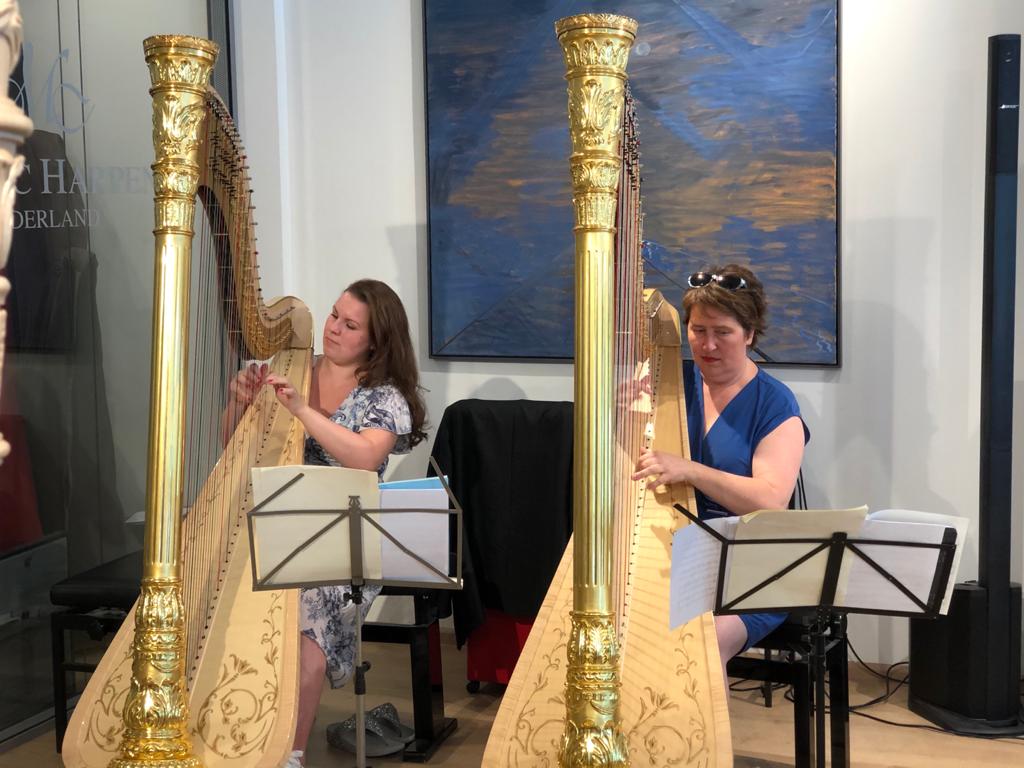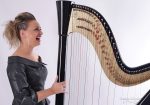
Recently I’ve been lucky enough to attend two masterclasses by wonderful teachers. Last week, Isabelle Moretti was working with the class of the Royal Academy of Music, and this weekend it’s been our great pleasure to welcome Patrizia Tassini to l’Espace Camac in Paris.
Jakez thanks Patrizia Tassini
Harpists have a lonely life. Usually you are the only one at school who plays the harp, before continuing to be alone in most of your professional walks of life - in the orchestra or chamber ensemble, while your instrument baffles composers, conductors and colleagues. This solitary state has its advantages. I was the only member of my former orchestra who was always on speaking terms with everyone, probably because I didn’t have to work closely with anyone. Sometimes you get work a flautist of the same level can only dream of. If you want to, you can convince many conductors that things you don’t feel like practising are impossible. But none of these perks are artistic. They are only opportunistic.
A large harp class such as that enjoyed by London’s RAM, or with Patrizia in Udine, does much to counteract a harpist’s unsplendid isolation. The harp world, though small, is still big enough even for those of us who travel around it constantly to be surprised and to learn, every day. Anyway, mastering any instrument is a Herculean task. Generally you need ten thousand hours of practice to be able to play virtuoso works - which in the profession today is just the beginning.
At the Royal Academy of Music
Listening to a great teacher give a masterclass is like finding many keystones of musical experience crystallised in one person: things you might otherwise need years to find. Even if your own teacher is a master themselves, they have to spend more time on the mundane aspects of your studies: writing in fingering, correcting hand position, pointing out where a run is not even, and so on. Your lesson is also private, focusing on what you alone are doing. A masterclass, on the other hand, is for many people to perform diverse works at concert standard. It is about the big picture: "how things are”, as Isabelle described it in London.
How are things? What’s really going on? Again and again, the same questions arise. Classical music is laden with universal difficulties - something I actually find quite heartening, because the more people who experience a problem, the less personally you need take it, and the more likely it is solutions will be found.
Take all musicians’ bête noire: the fear. Almost everyone is nervous when they play in a masterclass. You want to play perfectly, and classical music prizes the right note, the right way, in the right order. This is hard. Human beings are not designed to do exactly the right thing in the right order. As soon as this is demanded of us, we tense up and make more errors.
Still, we cannot opt out of fidelity to the score or analytical principles. Successful art has an internal logic that speaks to us. This logic is its language, to communicate what lies within, and all languages have to be learnt. Somehow, a musician has to reconcile rigour and perfectionism with ease and joy. You have to learn a difficult technique, and faced with something difficult, the human body braces itself. Paradoxically, the musician must learn to relax. You have to flex your wrist, feel and use the weight of your arm, articulate all your fingers fully and keep your hand supple. Research has shown that the sound of the harp (and the cello) are in part produced using the body of the musician behind the instrument. If you are tense, the sound will be too. Isabelle had some students breath out heavily, then play: the difference in the sound was amazing.
Later in the week, Isabelle showed me some extraordinary David Oistrakh videos. He uses the entire weight of his arm, with no compensation from the shoulders or anywhere else, and no matter how difficult the music, he could be writing his shopping list for all it makes him sweat. “Anyway”, Isabelle says, “if you are stiff, you will still go wrong: we all do. So you might as well breathe out and relax.”
In life, in music, your brain and your gut are inseparable. Can you sing what you play? Can you sense the melodic line rising and falling again, in the same way that everyone breathes? Can you conduct what you are playing? A body with no pulse is dead, and so is music. You can also be physically alive but clinically brain-dead - and if you practise mechanically, with no concept behind it, your fingers will never discover anything by themselves. Music-making is 80% about listening to yourself, and for all playing the harp is physically difficult, it’s only 20% about your hands.
Most of you will have read boring essays and programme notes by so-called musical experts, who tell you nothing at all about why or how the music is beautiful and important. Other musicians seem to delight in rubbishing bookish efforts out of hand, preferring “natural talent”. Both are wrong. You need your instinct, and you need your mind. You need to study and train, and you need to relax. It's a difficult paradox. But I guess it's the one from which art is made.


Thank you for this really helpful post, the first paragraph in particular expresses in a few words something that I have been trying to explain to my non-harp friends for years! My own relaxation is something I have struggled with for a long time, both at and away from the harp. I didn't go to the masterclass, but will take heart from Isabelle's words as quoted above. Thanks again!
Posted by: Katherine | March 21, 2012 at 11:58 AM
thank you for sharing. i agree relaxation is the most difficult part in harp playing, and is the essence of creating beautiful music.
Posted by: Donna Tsui | March 22, 2012 at 06:45 AM