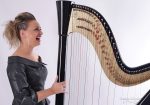
December’s Camac Voice is a lively piece of Celtic music. It is from a French artist whose roots are in Breton traditional music, but who in fact has become one of the most eclectic harpists we know of today. Nikolaz Cadoret began his harp studies on the lever harp, in Dominig Bouchaud’s famous harp class in Quimper, Brittany. A standard course of events would be either to use the lever harp as a stepping-stone to the pedal harp, or to become a lever harp specialist. Nicolaz, however, plays both instruments professionally - and that's not all: he also plays jazz, electronic music, and does a lot of experimental, improvisatory multimedia.
Two hornpipes: The Kildare Fancy and The Rights of Man
Nikolaz was the winner of the Camac Trophy at the distinguished Festival Interceltique de Lorient in 2010; a prizewinner at the Kan Ar Bobl Celtic competition; and has appeared as a soloist on top Celtic stages like the Rencontres Internationales de Harpe de Dinan, and the famous Breton dance gatherings "Fest-Noz". At the same time, Nikolaz pursued classical harp studies, firstly with Evelyne Gaspart in Rennes, then with Catherine Michel in Zurich and Xavier de Maistre in Hamburg. In the pedal harp field, he has won prizes at the USA International Harp Competition, Bloomington, the Reinl Wettbewerb in Vienna, and holds the Prix Philippe Chaignat from the Sommets Musicaux de Gstaad. He has held the Principal Harp position of both the Sinfonieorchester Aachen and the Komische Oper, Berlin, and regularly works with orchestras such as the Berlin Philharmonic, the Deutsches Sinfonie Orchester Berlin, and even as far afield as the Toronto Symphony Orchestra.
"I didn’t deliberately set out to become a harpist of many diverse styles", Nikolaz explains. "It happened by chance, because I began on the lever harp in Dominig’s class, and that’s not a class that just uses the lever harp as a beginning instrument before moving on to the pedal harp. So a serious approach to traditional music was instilled in me from an early age. I just knew I wanted to play the harp, and to express myself through the harp. If I need a classical instrument to say what I want to say, then I will go to the pedal harp; if I want to improvise, then I will do that; if I want to explore amplified music, then I will go to my blue harp.
Obviously, different styles of music nourish and inform each other. Your approach to all aspects of music – melody, harmony, rhythm, structure, how you approach a performance on-stage – everything is coloured by your fundamental training. It is like a painter who chooses to express himself in abstract forms, but knows how to draw precisely from life. His classical study informs his abstract work.
One example most harpists can relate to is the issue of improvisation versus the classical approach, which is more recreative than creative. I have a great respect for the classical devotion to a score, its wish to replicate the composer’s wishes as exactly as possible. But you will find many classical musicians, if they devote themselves exclusively to this, feel extremely uncomfortable attempting any sort of music that does not have a score to follow. To me, this state of affairs is actually a distortion of so-called "written music": up to the beginning of the twentieth century, the score was more a "grid" around which you were allowed and even encouraged to improvise! You can make music however you like, but perhaps your course should not end up actively blocking you from exploring any other types of music.
I see any performance as an event, your own event. Audiences don’t – outside the realms of competitions, which to an extent are artificial situations – come to hear a perfect rendition of a piece; they come to experience the event that you, the artist, creates. This feeling is self-evident for musicians who improvise, because you don’t know what is going to happen in advance – it has to be your event, what you decide to play is the entire sum of the event, not a score. Of course, when you play classical music, the score is an essential part of it. But you still, as a performer, need to be totally present yourself, and I find my experience with improvisation very helpful in reminding me of this.
Labo Polop V2 from polop projects on Vimeo.
One of my recent projects is an artists’ collective, Polop. It began with my brother-in-law, who is a photographer specialising in construction sites. One night we were sitting in a bar, and he said that he would like to branch out and do something with musicians, and I was interested right away. I went with him to see a construction site in the north of Paris, and I was bowled over by what I felt to be the sonic power of the place.
Polop project live 30/06/2011 by polopproject
Above: 55-minute improvisation in the basement of a construction site
Photo: Alexandre Soria
I wanted to work on something that explored relationships between not just different styles of music, but different art forms altogether. Little by little, Collectif Polop grew, and now mixes different musicians with videography, photography, sound engineering, etc. Our objective is always to bring different media together, so we always combine at least two art forms. I am trying to find the music in, for example, images, or video, or photography or dance. It’s like a big laboratory of different artists, all participating in work about – well, about freedom!
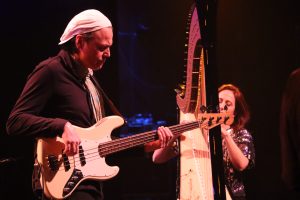
Another substantial project I’m working on at the moment is my harp duo with my wife, Alice Soria-Cadoret. We’re planning two tours for the next two seasons (2012-2013 and 2013-14), and both shows will present a panorama of Celtic harp music arranged for two harps - including its very diverse history. We’re going to perform these shows on electric lever harps. There is absolutely no reason why traditional music should always be performed on traditional instruments. By definition, traditional music has always soaked up the music and culture(s) in which it finds itself – which is why you get Celtic rock, or jazz/world fusion.
In music, or in art generally, I see no reason why you shouldn't do what you like, so long as you do it intelligently. If it wasn't intelligent it wouldn't be art, and different genres help us to explore art intelligently by teaching us things, by training us. But art is also about self-expression, and it's up to the artist to use his foundations to set himself free."
You can keep up with Nikolaz’s work on his excellent blog, as well as on MySpace.


Comments