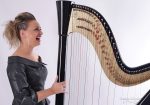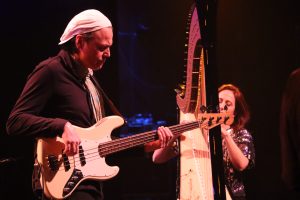
Many thanks to Alex Rider for such an intelligent review of the 'No Doubt': Concerto for MIDI Harp and Orchestra world premiere. I'm currently building a 'MIDI harp project page' for Harpblog, which will be a summary of our MIDI story so far. You'll find this review here, along with other comments from the No Doubt premiere and other MIDI events. There will also be some technical information and reports on the artistic projects that are being done with the harp. Once I get it all done, of course. I've set myself a deadline of before the World Harp Congress which is - really quite soon - but now I've told you all about it on the internet I'll have to do it
.
Any Doubts?: Some Thoughts on Graham Fitkin’s Concerto for MIDI Harp and Orchestra, its Contexts and Reception
ALEXANDER RIDER
On Wednesday 26 January, 2011, a new concerto for MIDI harp and orchestra (Subtlitled No Doubt) by Graham Fitkin was premiered by Sioned Williams and the BBC Symphony Orchestra under Andrew Litton at London’s Maida Vale Studio 1. There was already a certain amount of ‘buzz’ surrounding this premiere, which had itself been comprehensively and energetically promoted through seminars given by Williams at the Guildhall School of Music and Drama and Trinity Laban Conservatoire of Music and Dance, as well as managing to attract broadcast interest from programmes as diverse as the BBC’s In Tune and Woman’s Hour: anyone attending this concert could hardly fail to feel a sense of occasion. The performance was an auspicious start for this young instrument, developed with huge dedication over a number of years by Jakez François and Camac Harps. The soloist, delivery and the material itself were all highly engaging and purposeful and left a very satisfying impression on the capacity-audience.
In reflecting on this work however, this concerto raises some interesting questions about the direction of the harp as a concert instrument and the performance and reception of newer art music in general: not that the harp’s direction is in doubt, nor of course the growth and diversification of contemporary music, but rather in the way both of these are things are still perceived and critically received and the way in which harpists can effectively enter the arena of contemporary music.
Personally, I think one of the really exciting things about this new kind of harp is that it effectively releases the harpist from some of the more traditionally entrenched roles surrounding the classical performer. How? Because, the MIDI harp’s strings can be pre-programmed to trigger any sound conceivable by the composer, one is presented with an instrument that not only produces the usual sound of fingers on strings, but it also speaks! A capability immediately harnessed by Fitkin in his concerto, suffusing the work as he does with unedited vocal samples of politicians, proclaiming the indubitable existence of weapons of mass destruction in Iraq in the early 2000s. Whilst this kind of ‘sampling’ has been commonplace in electronic music, or in works for acoustic instrument and ‘tape’, these vocal sounds have never been seen to tangibly emanate from the harp itself. In this way, the harp can be seen to depart the traditional modes of performance (where interpreted meanings are usually strictly relational or subtly coded), and to enter the realms of political performance art, to shift from the abstract to the programmatic: no mean feat.
Music of sound conceptualization certainly helps this achievement, as Williams herself wrote in an article for the Incorporated Society of Musicians: “I have no interest in gimmicks, so it was important […] that the end result would be imaginative and serious”. Serious it most certainly was, composer Graham Fitkin’s vision of a work of “brutality and rawness”, that explores “communication, understanding and the human voice” and that “hovers between abstraction and narrative”, certainly delivered in terms of stark challenges to the stereotypical harp, as well as being a work that was of purpose artistically.
Yet, the baggage of the harp’s conservative media profile remains a spectre to it even when innovation on this scale is attempted: one commentator, on reviewing the premiere, quite straight facedly mused that “As a Concerto for concert harp it [the MIDI harp concerto] would need some work to convert it”: this mot juste (not) suggests two things a.) that this particular critic had missed the point of this work’s being a concerto for MIDI harp entirely and b.) that the very nature of instrument will always attract as much comment as the material presented. As another example of this attitude, one need look no further than the review of a recent programme presented by the London Sinfonietta, entitled ‘The Origin of the Harp’ (also the occasion of a harp concerto’s premiere, this time by Per Nørgard), where the Telegraph’s music critic casually denounced the harp: “The sound they make is almost too beautiful, and without focused musical material it can becoming cloying”. Were one to relocate those comments into the context of the piano or violin, the result is quite galling.
So, whilst Fitkin’s harp concerto has come into being in climate that is still subtly resistant to a harp that can not only challenge, surprise and innovate but occupy the solo stage full-stop, the most valuable thing to come out of this premiere remains in the questions—and answers-- that harpists must demand of themselves: can harpists, trained orchestral professionals or otherwise, wield an instrument that does not actually sound like a harp? Can one really be comfortable with eschewing ‘heavenly docility’ in favour of declaiming bitter political ironies to the audience? In discussing the work with colleagues, it is clear that this work makes them confront how they view their own instrument. As the MIDI harp soloist, Sioned Williams (who also commissioned the work) totally convinced in terms of both her concision and her commitment: if her performance is anything to go by then certainly anything is possible.


Comments