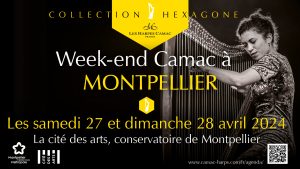
Today’s post is about the Parisian harpist Ghislaine Petit-Volta, professor at the Paris Conservatoire à Rayonnement Régional.
Ghislaine Petit-Volta studied harp with Brigitte Sylvestre, Pierre Jamet, Gérard Devos and Christian Lardé at the Paris Conservatoire, where she obtained a harp First Prize in 1981, and a chamber music First in 1982. From the age of seventeen, she regularly played with the great orchestras of Paris and Northern Europe – the Berlin Philharmonic, the Paris Opera, the Radio France Philharmonic, the French National Orchestra, the Paris Orchestra, the Paris Orchestral Ensemble, the Ensemble Intercontemporain, etc. Alongside her orchestral playing, Ghislaine is particularly well-known for her new music work. She has given many world premieres, for example with the Ensemble Fa, Musique Oblique, Court Circuit, Festival de la Criée (Marseille/France) and Festival d'automne (Paris/France), and works with composers such as Claude Prey, Félix Ibarrondo, John Cage, Ton That Tiêt, Lindolfo Bicalho, Eyrick Abecassis, Fineberg, Favio Daiban and Jean Marc Singier.
Ghislaine has also worked on many more unusual, cross-genre projects. Between 2002 and 2004, she appeared in a music theatre project by Lindolfo Bicalho for choir and harp, based on ‘Les Rechants du Mal Aimé’ by Apollinaire, Together with the Ensemble Choeur en Scène conducted by Emmanuelle Dubost, Ghislaine had not only to play the harp but also sing, talk, and make appropriate gestures, sometimes all at the same time. She also wrote a television film, ‘Un siècle de harpe’ about Pierre Jamet for the French-German channel ARTE. Her recordings include a collection of twelth-century French song, ‘Trouvères à la cour de Champagne’, with the Venance Fortunat Ensemble on Harmonia Mundi, Pierre Vellones’s trios with harp on REM, and ‘Pli selon Pli’ (‘Fold by Fold’) by Pierre Boulez, under Boulez’s own direction on Deutsche Grammophon. In 2005, Ghislaine founded the Antara Trio with two other soloists from the Ensemble Intercontemporain: Emmanuelle Ophèle (flute) and Odile Auboin (viola). Their trio is a great source of inspiration to all harpists seeking new flute, viola and harp music (have a look at the repertoire section of their website to find out more!).
Before she took up her teaching post at the Paris CRR (Conservatoire à Rayonnement Régional), Ghislaine taught at the Bourg-la-Reine/Sceaux CRD - the Conservatoire à Rayonnement Départemental. There, she instigated an annual blue harp festival that still continues today. This festival is a wonderful champion of the blue harp, always presenting it in different ways, and also always commissioning new works for the instrument. Blue harp repertoire that has resulted from the blue harp days in Bourg-la-Reine include Alain Louvier’s ‘Chimère Bleue’, Kilberic Deltroy’s ‘A Berlin’, and Christophe de Coudenhove’s intrieguing ‘Une harpe dans l’autobus’, a musical narration for blue harp and actor.
The CRR is a conservatoire in Paris where you end up with a licence, the French equivalent of a BMus, rather than a diploma. The only other conservatoire that offers this in Paris is the famous CNSM, the Conservatoire National Supérieur de Musique de Paris, popularly known as the ‘Paris Conservatoire’. At the CRR, students have their harp lessons on site, and their academic classes at the nearby Sorbonne university. Moreover, if you have the CRR licence, you can audition for the master’s course at the CNSM, which you cannot do with a diploma. Would-be undergraduates, take note: there is more than one conservatoire in Paris!
The CRR is also the only Paris conservatoire that offers a jointly practical and academic course for students from the age of nine. You have, as is normal in France, to pass a competition for places, and places are reserved for each level.
In her teaching, Ghislaine continues the spirit of innovation and versatility that characterises her own performing career. ‘I try to organise something new for the students every year,’ she says. ‘By the time they reach the licence level, my pupils have one and a half hours a week for their of private lessons with me, and an hour a week with my assistant for things like orchestral extracts, improvisation and sightreading, plus their academic classes at the Sorbonne. In addition to this, I always negotiate with the conservatoire to authorise extra classes. In December, Marie-Hélène Bouchaud will come to work on Tournier’s pieces with the class – she is one of Tournier’s last surviving pupils. One year, we did an exchange with Bourg-la-Reine and worked on the blue harp, and on another occasion, we had a triple harp at the conservatoire for four months to get to grips with. Another thing I have organised this term is an hour and a half a week where we all, myself included, learn Renaissance and Baroque dances.
‘I enjoy the variety – I teach because I want to learn myself, all the time ! We all learn, both from the projects we do, and from each other. I’m always learning from my students. In any case, I think it’s very important that today’s young harpists are educated to be as versatile musicians as possible. There are fewer and fewer classic jobs such as orchestral positions, and almost everybody will have to go out and create work for themselves.’