Next week, many young harpists will travel to Israel for what was the first, and is the longest-running international harp competition in the world. The International Harp Contest in Israel is fifty this year, and its winners are among the harp's finest artists today.
Very many thanks to Esther Herlitz, the competition's director, for writing the following article for me in celebration of this great competition.
Esther Herlitz was born in Germany and educated in Jerusalem. She served as an officer in the British Army in the Second World War and in the Israel Defence Army during Israel’s War of Independence. A graduate of Israel’s first school for Diplomats, she served in Israel’s Foreign Service from the time of its inception. She was Director of the Ministry’s Public Relations and Information Departments; a member of Israel’s UN delegation; First Secretary at the Embassy in Washington; Consul in New York and Israel’s Ambassador to Denmark 1965-1971.
Miss Herlitz was the Director of the Labour Party’s International Department 1958-1962; a member of the Tel Aviv City Council 1961-1965; at the request of Prime Minister Golda Meir she founded the Israel Voluntary Service of which she was Chairperson from 1972 till 1978. She was a member of the Eight and Ninth Knesset representing the Labour Party, and served on the Law and Constitution, the Foreign Affairs and Defence Committees, as well as the Committee on the Interior.
Miss Herlitz was a member of the Israel Committee on the Status of Women. She is the Chairperson of the Friends of Denmark in Israel; a member of the Board of Trustees of Ben Gurion University of the Negev; the Board of Overseers of the Hebrew Union College in Jerusalem. She was appointed Director of the International Harp Contest and the Zimriya (World Assembly of Choirs in Israel) in 1983.
Esther Herlitz has published an autobiography, “How far can a Woman Go” (Ministry of Defence Publishers 1995). She has also been awarded “Freeman of the City of Tel Aviv” (1996), Doctor Honoris Causa by the Hebrew Union College (1999), and is the recipient of the Prime Minister’s Shield for Voluntarism.
Miss Herlitz was the Director of the Labour Party’s International Department 1958-1962; a member of the Tel Aviv City Council 1961-1965; at the request of Prime Minister Golda Meir she founded the Israel Voluntary Service of which she was Chairperson from 1972 till 1978. She was a member of the Eight and Ninth Knesset representing the Labour Party, and served on the Law and Constitution, the Foreign Affairs and Defence Committees, as well as the Committee on the Interior.
Miss Herlitz was a member of the Israel Committee on the Status of Women. She is the Chairperson of the Friends of Denmark in Israel; a member of the Board of Trustees of Ben Gurion University of the Negev; the Board of Overseers of the Hebrew Union College in Jerusalem. She was appointed Director of the International Harp Contest and the Zimriya (World Assembly of Choirs in Israel) in 1983.
Esther Herlitz has published an autobiography, “How far can a Woman Go” (Ministry of Defence Publishers 1995). She has also been awarded “Freeman of the City of Tel Aviv” (1996), Doctor Honoris Causa by the Hebrew Union College (1999), and is the recipient of the Prime Minister’s Shield for Voluntarism.
Reason for a Celebration – The Israel International Harp Contest's Jubilee
by Esther Herlitz
The State of Israel was hardly ten years old when A.Z. Propes, then on the staff of the Prime Minister's office, suggested, in order to attract visitors to hold an International Harp Contest in Israel, since no such Contest existed anywhere in the world. Israel, he thought, was best suited since the harp originated in the ancient Middle East.
The first International Harp Contest took place in Jerusalem in September 1959 and since then every three years. The 17th Contest, the Anniversary Contest, will be held 6th – 20th October 2009.
Music plays an important role in Israel's life. I believe, it is the only country in the world, where one can test as an "outstanding musician" and be assigned to military duty able to continue study and produce music while in the Army.
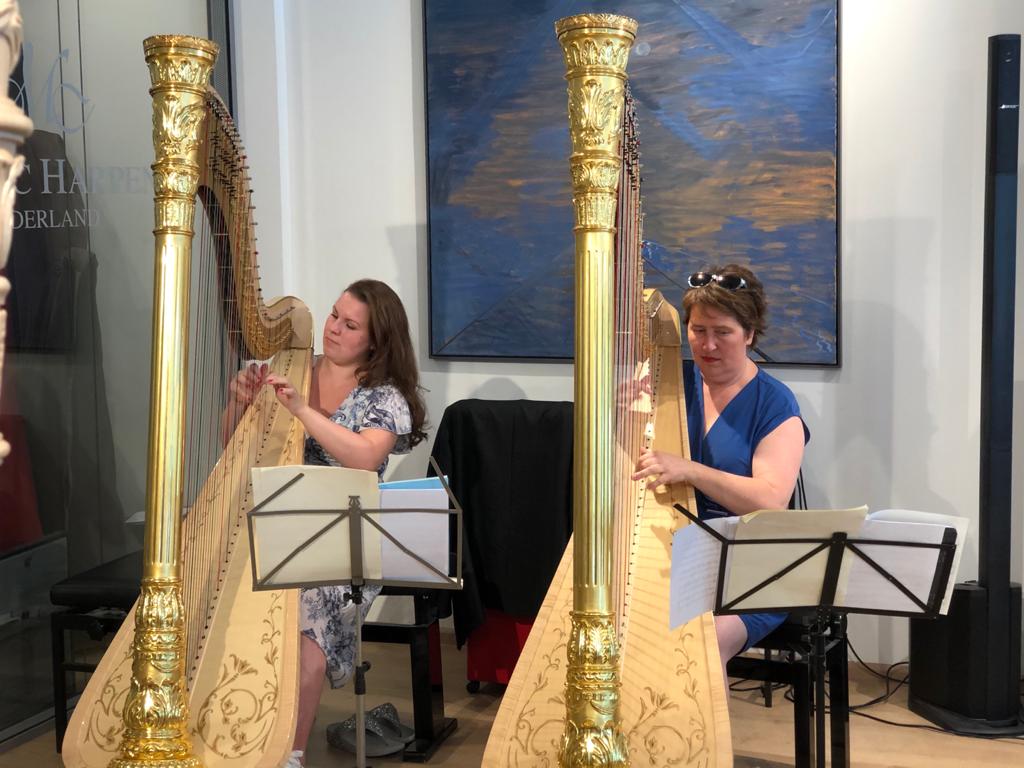
The harp is shrouded in mystery. Fifty years of tri-annual contests in Israel have not made the harp as popular as it was in biblical days. The present day concert harp in use since the beginning of the 19th century is beautiful and like its ancient predecessors often gilded. Audiences see it in the orchestra and admire its beauty. They hardly hear it, few know that it is played with both hands who work its 47 strings, and two feet who work seven pedals.
Even the name of the instrument raises questions. The Hebrew Bible refers to King David playing the "Kinnor" for the ailing King Saul. The "Kinnor" is used in modern Hebrew for violin. Yet the whole world refers to King David playing the "Harp". The Hebrew Bible talks about the Levites and prophets playing the "Nevel", the word used today for the harp. The culprit for the mix-up is the Septuaginta, the translations by 70 sages of the Bible into Greek, using the same Greek word for both Kinnor and Nevel.
The origin of this string instrument is in the ancient Middle East. In the National Museum in Baghdad we find the oldest known harp from the site of Ur of the Chaldees, dating to 3000 B.C. At the Louvre in Pars, there is an Egyptian harp from approximately the same time. At the Israel Museum in Jerusalem, there is an ivory engraving, found in Megiddo, showing harp players. Israel's half-Shekel coin features a harp copied from a coin of Bar-Kochba's vintage. The harp is mentioned numerous times in the Bible; it was used by priests and prophets and was part of the service and ceremonies in the Temple in Jerusalem. Josephus talks about 10,000 harp players in the Temple built by King Salomon.
We wish we knew what music these harpists of ancient days played. It is believed to have been joyous; hence, the exiles from Jerusalem in Babylon hung up their harps and refused to play (Nabuco). Today, one of the harp's problems is the lack of repertoire, especially of concerts for harp and orchestra. The first Israeli Contest, still in its planning stages, commissioned a work for harp by composer Paul Ben – Haim (Poem). The Contest, ever since, has commissioned a work to be played in the first stage and rewarded by a Prize, now named after Propes. Israeli composers, like Ma'ayani and Natra, took on the challenge of writing harp music and their works for harp are by now played world-wide.
The first Contest 50 years ago set standards regarding the choosing of contestants, their age, the Jury, all these are strictly observed to this day. There were Rules and Regulations as well as a Legal Committee from the first day. In these 50 years over 500 contestants under the age of 35 from numerous countries took part in 16 Contests in Israel. At the sixteenth Contest, at long last, the first Israeli, Sivan Magen, won the First Prize. All laureates of the Israel Contest have made exceptional careers in orchestras, chamber music groups, as soloists and as teachers. Many of them will play in the Anniversary Concert on October 6th with the Israel Philharmonic Orchestra.
Harpists are few and lonely on the music scene. The Israeli pioneering Contest and those that have followed elsewhere, have created a "togetherness" of harpists, whether contestants, jury members or guests. Propes gathered at the first Contest as members of the Jury the elite of the harp world. Suffice it to mention Salzedo, Grandjany and Zabaleta, as well as Pierre Jamet, Phia Berghout, Ms Aldrovandi and Lucille Johnson. There were, believe or not, more men than women. These luminaries met each other in Israel for the first time. The American Harp Society was founded in Jerusalem. Regretfully, none of these great musicians are alive to celebrate with us. Many of the early contestants have enriched the musical life and later founded the World Harp Congress.
The Contest helped to introduce the harp to the general public. People like contests and will follow them, whether football or music. The Harp Contest helped to move the harp out of the salon unto Concert Stage and to the media. All Israeli Contest Stages have been open to the public, who can at long last see the harp and harpists front stage. Harp playing is now transparent.
The Israel Philharmonic Orchestra and Maestro Zubin Mehta, have contributed greatly to the standing of harp playing by performing with contestants. What a pity there are no more concerti for harp and orchestra to choose from. We are privileged to have Maestro Mehta as the President of the Israel Contest's Jubilee events and its Honorary International Committee.
We should mention that the harp inspired many artists. The most prominent painting is Rembrandt's King David playing the harp. Marc Chagall's beautiful tapestry in the Israel Knesset (Parliament) shows King David playing the harp on his way to Jerusalem. Chagall also designed a golden coin for the International Harp Contest in Israel. In honor of the Contest's Jubilee, the Israel Philatelic Service has issued a special stamp showing a harpist playing.
At the age of fifty, one contemplates the past and the future. The ancient harp played by King David has changed considerably through the ages. But thanks to the Contest, the harp remains center-stage in Israel's musical life and turns international attention toward beautiful Israel.
The Israel Harp Contest hopes it has done justice to this unique, rich and noble instrument. Being Fifty is also a time to celebrate: Happy Anniversary.
Esther Herlitz