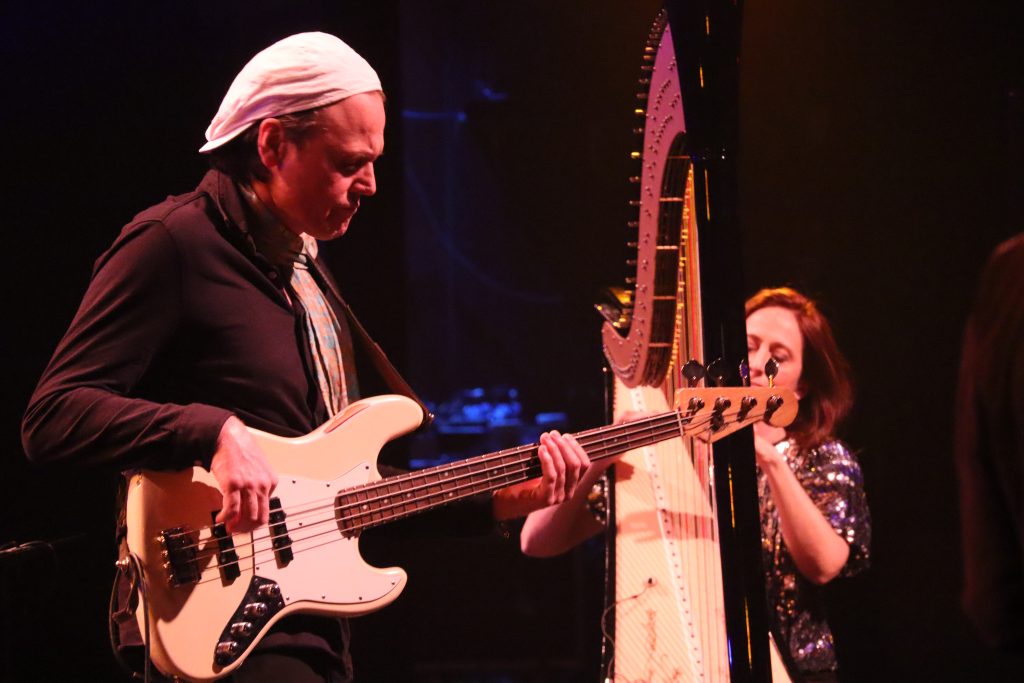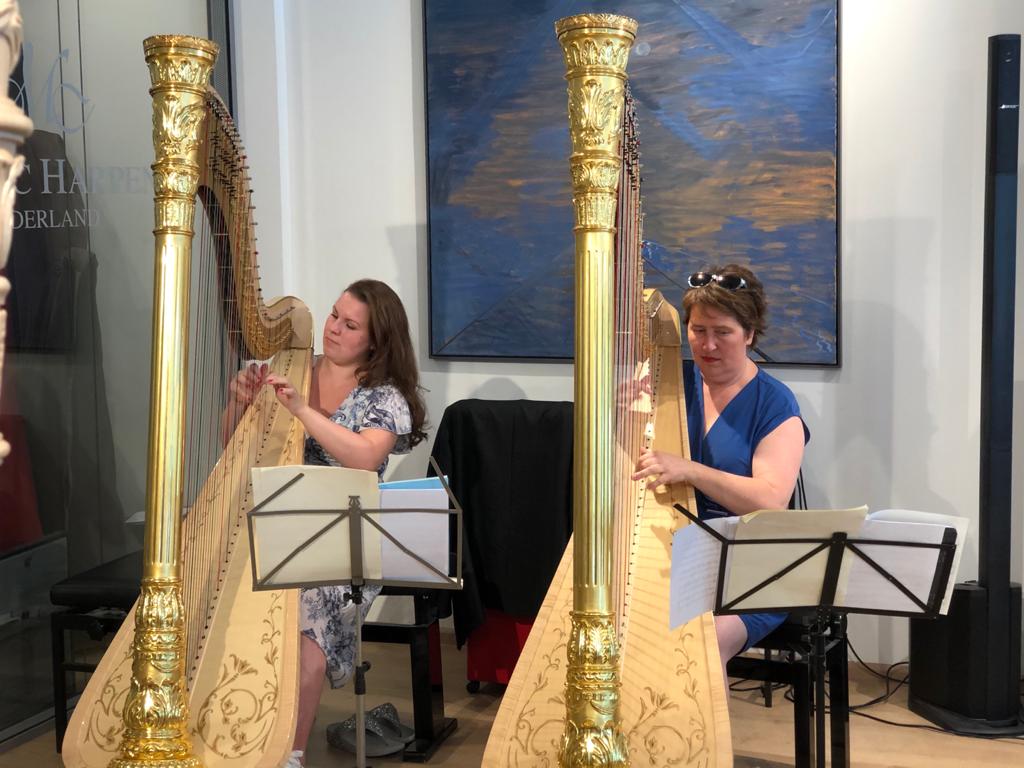
He Plays the Darbuka, She Plays a Turkish Harp More interesting harp CD news from Turkey: Sirin Pancaroglu and Yinon Muallem´s Israeli-Turkish percussion-harp album Telveten, now out on KAF Müzik.
Erez Schweitzer
Ha’Aretz, Monday, May 11, 2009
Many extremities meet in the joint album of Yinon Muallem and Þirin Pancaroðlu, an Israeli musician living in Turkey and an internationally-acclaimed Turkish harpist, but the main surprise does not lie in the fusion between east and west or between tradition and progress, which has already become cliché. The album is so delightful because it feels as though it presents no real innovation, and yet, it does not resemble anything that was done before. Therefore, the encounter it offers is very peaceful and very exciting at the same time. It is easy to give in to its exquisite beauty, but it also presents a riddle, which is not easily solved.
Muallem is an excellent percussionist, who played in the past with Omar Faruk Tekbilek and directs his own ensemble. In recent years, he has been living in Istanbul, where he has deepened his knowledge of the region’s musical traditions and has collaborated with local musicians. Pancaroğlu is a harpist with a classical background, who also preserves the tradition of playing the cheng (çeng), an ancient Turkish harp. Muallem was the one to initiate their meeting after hearing her solo album, but she was somewhat hesitant about combining the classical harp with percussion instruments such as the darbuka, the kanjira (an Indian frame drum), and the zarb (a kind of Persian darbuka). These hesitations disappeared, the two say, when they started playing together a piece by the French Baroque composer François Couperin.
Indeed, the fusion of Pancaroğlu’s harp and Mallem’s percussion instruments sounds completely natural in this piece by Couperin, which like the rest of the pieces in this CD is very rhythmic. The choice of such compositions is understandable. It is easier to fuse rhythm with rhythm than two extreme harmonic worlds. Nevertheless, even though melody acquires a secondary place in the rich rhythmic texture of the album, it still has a significant place. Melody is what prevents the album from becoming another meditative album of improvised pieces of percussion instruments and string instruments (even though here this role is taken by the harp and not by the oud) and on the whole, it gives more weight to the album’s Western traits.
In other words, although Muallem fills up every available space in the album with brilliant and inspiring playing, Pancaroğlu and her harp are the ones to set its tone. This is true when the two play traditional music from Azerbaijan and Turkey and also when they play an Argentinean tango by Carlos Gardel or a piece by the Spanish composer Mateo Albéniz – more than folklore research, it gives the feeling of Baroque classical music that was sped up or slowed down, or at any rate, was taken out of context. The melodic basis and the repetitive structure are always retained, even though it is composed of a texture of rhythms, whether played by the percussion instruments or by the harp. This basis prevents this texture from falling apart and gives the album a lyrical momentum, unending musical interest and an emotional core, with which it is easy to identify and to which it is easy to return.
It seems that here lies the charm of this album. There is something fascinating about the encounter between the album’s lead instruments as well as between the distinct musical worlds they represent, but this is not its main feature. Much more important are the choice of the wonderful repertoire and the retaining of its beauty even when it is repackaged in a cover that offers its own richness. The album can be described as a musical journey around the world – modern Italy is represented in it, for example, by the theme of the soundtrack for the movie Life Is Beautiful (La Vita è Bella) composed by Nicola Piovani, and the Iranian kemenche player Arslan Hazreti appears as a guest artist in some of the pieces – but this would be a mistake.
It is hard to position the album, both geographically as well as historically, and this is part of its power. It seems that it springs up first and foremost from the personal encounter between two skilled and sensitive musicians and between their musical inclinations; their openness and obvious enjoyment of each other in this encounter is inspirational. Maybe this is the reason why, in spite of its musical complexity, it has something almost popish about it, that is, captivating directness and openness, which make it a meaningful experience.
Yinon Muallem and Şirin Pancaroğlu, Telveten, KAF Müzik
You can order the CD here.