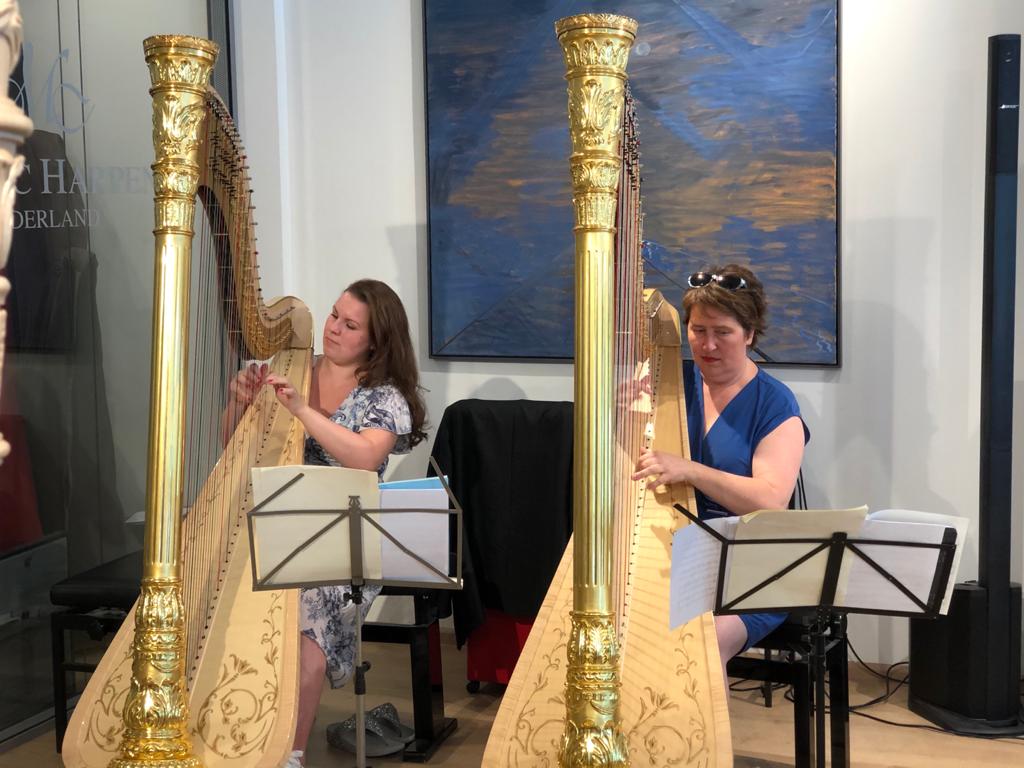
We're all back from the Camac Harp Days in London, three fantastic days of concerts, workshops, lectures, parties, and the launch of our new Midi Harp!
The Camac Harp Days focused on early and contemporary music, an idea we came up with after inviting Constance Luzzati to give her London debut at the festival. She specialises in juxtaposing early and new music in her recitals, so we decided to extend her concept to the festival as a whole.
Gabriella Dall'Olio and her chamber ensemble of colleagues from Trinity College of Music played the opening recital on March 31st fabulously well. Gabriella also chose fabulous repertoire - by no means a given in the harp world - and which is something doubly tricky to bring off in a programme consisting entirely of premieres, as this programme did. Tim Jackson's Be Not Afear'd is a haunting, deeply serious work after Caliban's equally beautiful lines in The Tempest: "Be not afear'd, the isle is full of noises, / Sounds and sweet airs, that give delight and hurt not...". Interestingly, Jackson's piece exists as a harp solo, or for a chamber group of harp, string quartet, flute and clarinet. It is even more beautiful in the ensemble version, and for those of you looking for repertoire for the same line-up as the one you need for Ravel's Introduction et Allegro, I absolutely recommend it.
Errollyn Wallen's English Folk Songs for voice (sung here by Errollyn herself), harp, clarinet, flute, viola, cello and double percussion is another wonderful work. It's witty, inventive and moves between lyrical and drivingly rhythmic sections, to great effect. Unfortunately I missed Amir Mahyar Tafreshipour's Chang e Rudaki because I had to go out of the concert hall and do something (it's uncut, this report ), but I do know that his harp concerto A Persian Reflection is excellent. Chang e Rudaki ("Rudaki's Chang") is inspired by the Persian poet Rudaki, who wrote over one hundred thousand lines of poetry, and who was particularly fond of playing the chang, and early type of Persian harp. Gabriella performed Chang e Rudaki on the lever harp, so it is a substantial addition to that instrument's repertoire too.
Excellent, unusual repertoire was the order of the day throughout the festival. If you are interested in early music, don't miss a chance to hear Frances Kelly, who performed a programme exploring Continental influences on English music, in duo with lutist David Miller. The following day, she also led an excellent workshop on music in England, 1600 - 1660.
Rhodri Davies unfurled A1-size graphic scores to help us get to grips with Catherine Kontz's Tea Ceremony, a "guided improvisation" around the ideas of the Japanese tea ceremony. In the evening of Monday, March 30th, Constance Luzzati gave her London debut, with a stunning, virtuoso mixture of early and modern works. Bruno Mantovani's Tocar is an excellent new solo work, and Constance's own transcription of Froberger's Lamentation is a beautiful, unusual alternative to the Bach, Rameau and Scarlatti most harpists are playing at the moment.
Wednesday, April 1st began with a packed hall and a collaboration with Trinity College of Music's composition department. The composition students had been working with student harpists, and a Blue Harp Camac had loaned them in advance to work with. People do use the Blue Harp a lot for things like chill-out music, because you can amplify it and it looks cool, but it's a serious instrument capable of serious music and we were delighted with what Duncan McCleod's nine students had created. Lucy Smith's "Electric Arc" stood out as an intelligent exploration of electric and acoustic effects, and the dialogue between the two. Oliver Paine proved that serious does not have to mean humourless: his "Beep Test" makes the harpist keep up with electric beeps, the way you have to if you take the "beep test" in the gym.
In the evening, Jakez launched the new Midi Harp. Jakez has dreamed of creating this instrument for the last twenty-five years, and now, finally, his dream has become reality. Assisted by Trinity's Head of Composition Dominic Murcott, Jakez explained that while a Midi Harp can sound like a piano or trumpet instead of a harp and that is fun, this isn't the aim of the instrument. Any Midi instrument can sound like anything, because the sound is generated by a computer receiving a signal from the instrument. A harp sounding like an electric guitar isn't exciting for musicians already accustomed to Midi keyboards, but a harp that can be used in significant engagement with computerised music is something else entirely. It is particularly important in the relationship of live performance and computer music, a relationship at the heart of the music of today.
Watch this space for further developments with the Midi Harp's music. I can't tell you about them all yet, but I can announce that Sioned Williams has commissioned the first concerto for Midi Harp and Orchestra by Graham Fitkin. This will be performed by Sioned and the BBC Symphony Orchestra in London in 2011.
Sioned is a pioneer of new music in Britain and abroad. She also gave an excellent lecture-recital on collaborating with composers to expand the harp's repertoire: "New Music, Innovation and the Importance of Collaboration". With the exception of Amir Mahyar Tafreshipour, who Sioned particularly has championed in Britain, all the musical examples she chose were British: Michael Stimpson, Julia Stimpson, Anthony Bolton, David Graham-Ellis, Gareth Glyn, Cyril Lloyd, Patrick Piggott and Sue Rothstein.
The final day of the festival, April 2nd, welcomed Isabelle Perrin, who gave a masterclass in the morning and a concert in the evening. This didn't have anything in particular to do with early and new music, but the Camac Harp Days is a festival that takes place in a music college, and as such was something we wanted to orientate around Trinity's students. They worked extraordinarily hard, not only with composers on Blue Harp pieces, but they also gave no less than three magnificent concerts (two solo, one chamber) of the most demanding, top-quality repertoire. Tamara Young is to be particularly congratulated on her performance of Berio's Sequenza II, a work fully-fledged professionals often need six months to learn, but they were all great. We wanted to include a really good classical masterclass for them, for their core repertoire, and really good it proved to be.
Isabelle Perrin is a very special artist for me personally. I had decided, as a London-based 24-year-old freelance harpist playing mostly in hotels, to try the Ludovico Competition in Madrid, so to prepare I signed up for a course Isabelle offered in Castelleone, Italy. I had hardly ever played a note outside Britain at the time and I remember my then boyfriend had almost physically to push me onto the plane, I was so nervous. But three hours later I arrived to find a world of music and musical attitudes I had never experienced before: of Parisian discipline and exactitude, of international horizons stretched out limitlessly before us. I absolutely loved it. In four days, Isabelle totally changed my perceptions of harp-playing.
Isabelle is an exceptionally disciplined artist: you can choose the musical decisions you make, but you have to have a reason for them, and you need to work hard enough to be able to express them clearly, even for the back of the hall. Isabelle's playing is brilliant; her teaching is wise and compassionate, and above all it is her discipline which I like so much. Perhaps discipline is at the heart of all classical art forms. I love ballet, but almost more for its iron discipline than its magic and romance. You need the hard work to make the magic real, and I'm very interested in realities. As Tadeusz Baird said:
"Być artystą nie tylko z nazwy, to znaczy być z usposobienia marzycielem i umieć marzenia bez względu na cenę urzeczywistnić, a do tego siły woli."
["To be an artist not just in name only means to have a dreamer's nature, and to be capable of turning dreams into reality"]
Isabelle's concert in the evening marvelously realised everything she upheld in her masterclass, and met with louder and more sustained applause than I have heard in London for a long time.
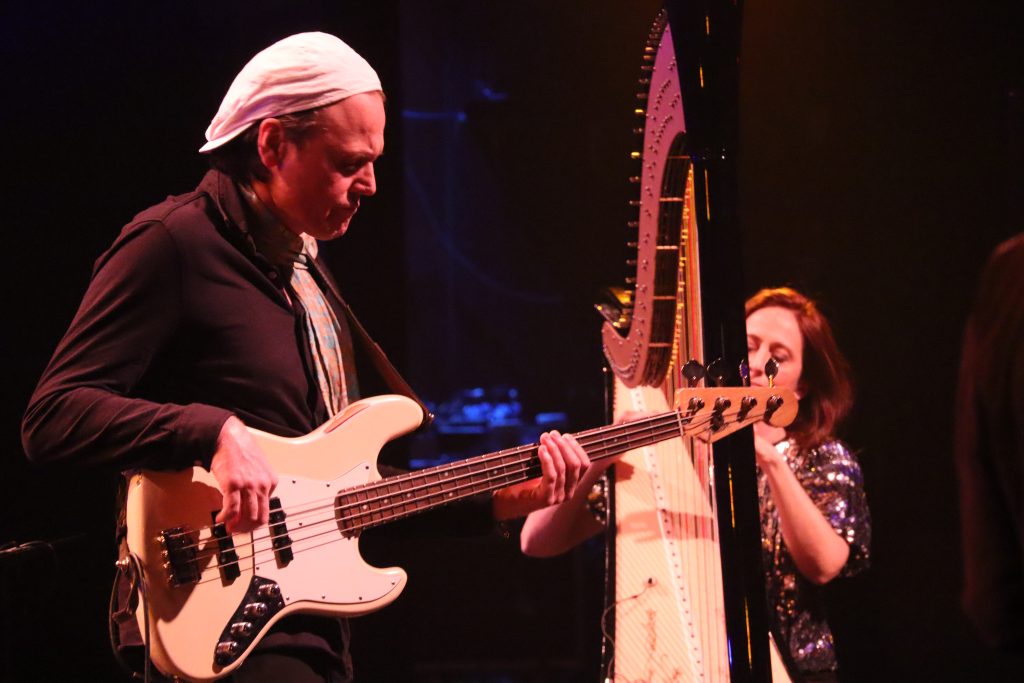
For the festival's final performance, Jakez took to the stage himself, in a jazz trio with Tim Sampson and Joe Stoddart. They gave us a brilliant display of yet another side to the harp (The Minstrel's Farewell To His Native Land will never be the same again), with both lever and pedal harps.
Huge thanks to everyone who worked so hard to make this festival happen: to Gabriella Dall'Olio, Frances Kelly and their wonderful students at Trinity College of Music; to the artists who came to perform for us so inspiringly; to the composition and jazz students and professors who engaged with our new instruments with such passion and commitment.
Very many thanks too to Yvonne White of WhiteGoldImages for the beautiful photos!
Camac service: not only can Alexis move and regulate your harp, he can get your baby off to sleep.